
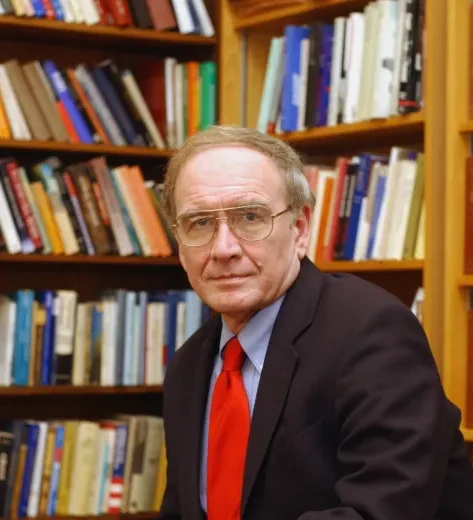
John Lewis Gaddis is the Robert A. Lovett Professor of Military and Naval History at Yale. Named the “Dean of Cold War Historians” by The New York Times, his landmark works include Strategies of Containment, The Cold War: A New History, The Landscape of History, and On Grand Strategy. In 2012, Gaddis won the Pulitzer Prize for the official biography of the diplomat George F. Kennan. A recipient of the National Humanities Medal who advised President George W. Bush and his speechwriters, Gaddis is the founding director of Yale’s Brady-Johnson Program in Grand Strategy and winner of multiple undergraduate teaching awards. Gaddis has incorporated AI into both his teaching and his research, using it to test the same questions about patterns, judgment, and interpretation that have defined his work for decades.
In your class, you had students interrogate AI—take its answer, then push back and ask how it knows what it claims to know. So I ran your experiment on you. I asked ChatGPT who John Lewis Gaddis is, and it gave me the highlights in tidy bullet points: Pulitzer Prize winner, Yale professor, Cold War historian. Now I’m asking you. Who is John Lewis Gaddis, and what’s a favorite or defining moment from your career that no chatbot could capture?
There’s a short autobiography I wrote six or eight years ago, about growing up in Texas—that’s a better place to start than a chatbot or Wikipedia.
What that essay captures, and what no chatbot could, is how accidental almost everything about my career was. I wasn’t setting out to become a historian. Everyone expected I’d become a doctor, or a scientist, or a rancher, or that I’d run the drugstore—I wasn’t any good at any of it. I got sent to Rice University, where I couldn’t manage the calculus, and I was headed toward becoming a librarian, until I got so frustrated typing a single catalog card that I rebelled and said no. Then a professor called me into his office—the first time I’d ever gone to office hours—praised a paper I’d written, and told me I could become a historian. That had never occurred to me.
Homer has a phrase for it: “the man of twists and turns.” That’s what my career has been, and no Wikipedia article or CV line captures that. A teaching stint at Newport 50 years ago, which I never expected, is what got me interested in grand strategy in the first place. My connection with Kennan [George F. Kennan, diplomat and architect of Cold War containment policy, whose official biography Gaddis later wrote] was a long shot for both of us, but it worked out very well. Coming to Yale happened only because my first marriage was ending and I didn’t want to be lonely in that small town any longer—and then, by pure chance, Toni’s [Toni Dorfman, who Gaddis married in 1997 and who teaches theater studies at Yale] marriage was ending at the same time. That was the luckiest thing that ever happened to me. Wikipedia doesn’t know any of that.
Being here [at Yale] gave me the freedom to teach whatever I wanted—big lecture courses when I felt like it, and now that I’ve tired of those, the undergraduate seminars, which I love more than any teaching I’ve done. I never expected to teach first-years; I spent most of my career teaching graduate students and wasn’t sure I’d know how to talk to first-years. I learned quickly.
And I never wanted to be bored, or to keep working on the same thing. I started in diplomatic history, moved into grand strategy, then backed into biography without ever meaning to become a biographer. When the Cold War ended, I ventured into political science, and into the failure of efforts to predict its ending. Then 9/11 happened, and I improvised a book on it, which led to some lecture work and a bit of involvement in the policy world—including a call to the White House that didn’t amount to much, but was interesting in how it happened, purely by accident.
If I had to say what I’d like to be remembered for, it’s that: not settling into one kind of history, but having had the freedom to jump from one thing to another. That upsets publishers to no end, which is part of why the book I’m working on now has been such trouble to place. I wouldn’t have expected, at this stage, to have any difficulty finding a publisher, but I have—simply because publishers don’t like it when you jump categories. That’s what I’ve done my whole life, though, and it’s what I like to do.
AI fits the same pattern. I only know as much as I do because I teach a seminar where my students end up educating me rather than the other way around. I knew nothing about AI five or six years ago; my students have been teaching me as I go, and then I try things out on other students. So I know enough, in a vague and pretty superficial way, to track new developments—large language models, colorizing old photographs, that kind of thing. But all of it came from my students, not the reverse. None of that is in Chat or Wikipedia either.
Today, many people view the rise of AI as a revolution in its own right. A revolution signifies transformation; something that changes how a society lives and behaves. Do you consider the emergence of AI to be a revolution or more of an extension of an existing technological shift?
I think it is close to being a revolution, in the sense that it is going to change the way we think and the way we operate in substantial ways. It may be comparable to the invention of steam propulsion in the early 19th century, the development and application of electricity in the late 19th century, or even the development of aviation in the 20th. It is fundamental, but AI is less visible because those developments were all highly dramatic. You could see locomotives charging down the tracks. You cannot quite see AI coming, but you know it is there.
Is it more fundamental than the development of the web and the personal computer half a century ago? I am not sure. If you go back to how we operated before we had PCs, and certainly before we had the web, it was a very different world, and you would find it completely unrecognizable. So you might argue this is really the second computer-related revolution, the first having been the development of the personal computer and the linkages that were subsequently created in the 1960s, which turned out to be the internet.
Historians study disruption for a living. Every major information technology has changed what counts as a reliable source, from oral tradition to printed books to digital archives. Where do you think AI-generated text fits into that lineage?
I think it is creating, or is going to create, a pretty fundamental difference in how we think about reality, particularly in the academic disciplines. I made an argument 30 years ago, in a book called The Landscape of History, that there are two kinds of sciences. There are the reductionist sciences, the social sciences, that try to reduce everything to a single independent variable—the class system, the market economy, the invisible hand, whatever it is. This model was supposed to let you predict the future, and it did not do that very well. But there was always a different kind of science, which I called the evolutionary sciences: astronomy, evolutionary biology, geology, paleontology. Here, there is a whole complex of variables interacting with each other. This model is less ambitious about prediction, but I think it is much better at detecting reality, because it mirrors its intricacy.
I was arguing this in lectures I gave at Oxford back in 2001 and 2002, later published as that little book. All of my political science and economist friends stopped speaking to me when it came out, because they saw it as subversive. Historians did not entirely understand it either, so it fell a bit flat at the time. But I feel vindicated now by the development of large language models (LLMs). The world is full of variables, all interacting with each other, and what these new technologies give us is the capacity to aggregate the results and understand them more clearly. I think that is a substantial intellectual revolution, and it will, in time, reinforce the validity of the historical approach and place history much more clearly in the evolutionary sciences, alongside geology and paleontology. At the same time, it will undermine the single variable disciplines, like political science and economics, and perhaps sociology and psychology.
The problem my profession always had was that we were completely overwhelmed by information. And so, we were very casual about drawing patterns. I believe LLMs are closer to the way historians actually think than the old reductionist model ever was, in the way they measure and evaluate data holistically, balance them, and see patterns that we are not able to see on our own.
When I was writing my still unpublished Texas book, I had something like 25 large archives, filled with material on one small town. Probably a hundred thousand documents, all on that one town. That is why it took me six years to write, because I was looking for patterns across all of it. If I had had the skill to work with LLMs from the start, the whole process would have been faster. I think historians are in a better position now, as a result of these technologies, than they were even five years ago.
In the first-year seminar I teach, What History Teaches, I regularly throw twelve hundred pages at my students. This year, I asked them to become LLMs themselves, to sort it out for their own purposes, and they were all pretty skillful at doing that. So, I am optimistic about the future of the study of history and the historical profession. If I were a political scientist, or an economist, I think I would be worried about the future of those disciplines, because they are too reductionist.
With the use of LLMs, the job of the historian could become easier. However, the dangers associated with AI, such as hallucinations and deepfakes, raise many concerns. Could this affect the integrity of the archival process?
Of course, it is dangerous, but hallucinations are nothing new for historians. We have always had historians who went off on strange tangents, manipulated information, worked from a preconceived point of view, or were simply incompetent in the first place. I have seen all of that across my career. That is why we have debates in history whenever a book comes out: is it based on hallucination, or on reasonable analysis? I do not think this is any different in kind.
How have you used AI to experiment in your classes? What have you noticed?
I know from the start that my students are going to use it, so I am not naive enough to say don’t. What interests me much more is influencing how they use it, not whether they use it at all.
That is why one of the assignments I gave my students was to write a five-page autobiographical essay, and then give it to AI to grade, and then grade AI’s grade on their own essay. That forced them to separate themselves from the AI, at least in theory. It was interesting because what a lot of them found was that AI, faced with a five-page essay from a first-year student, tended to pat them on the back and tell them it was the greatest thing since Plato. They saw through that, and they went back and said, “Come on, toughen up, tell me what you really think.” They could manipulate it, challenge it, and it would get tougher, more analytical, more useful. I thought that was immensely valuable: do not take the first thing that comes out of the computer. Ask it, “How do you know that? What is your basis for this?” They could even ask whether it was trying to pull the wool over their eyes. I thought that was a useful exercise.
Something I tried that was less successful was putting the writing checklist [a set of writing rules Gaddis requires all his students to follow] through AI. Part of the fun of that checklist is that it makes important points about writing with a sense of humor, some jokiness. I am not yet convinced that LLMs have a sense of humor. I could be wrong, but what came back was pretty stodgy, so I did not put much weight on that experiment.
For research, though, for working with large bodies of empirical information and finding patterns in them, I think it is immensely useful.
A third use is a kind of note-taking. If I give you 1200 pages of Tolstoy, you are not going to take 100 pages of notes. You are trying to remember what happened when, say, Andrei passes under what looks like a dead oak tree one evening, and the next day the tree has sprouted and greened. Where in 1200 pages does that occur? You can ask, and it will tell you immediately. That is useful. It is an acceleration of note-taking, not a replacement for having read the book in the first place, since you needed a reason to ask the question. But it saves you flipping through 1200 pages.
The other use, less relevant to my What History Teaches class but central to the time travel class I teach [Time Machines: Reimagining the Past] in the spring, is AI as a kind of time machine. I take old black-and-white footage, experiment with movie cameras from a hundred years ago or more, and AI smooths it out and colorizes it, so you can be on the streets of Paris in 1900, in full color, at normal speed, without the jerkiness of the original film. That makes the past far more vivid than a black-and-white photograph ever could. The colorization process has gotten good enough now that you can take still photographs, the kind I used in my Texas manuscript, and it will sharpen them if they are blurry and line them up neatly on the page. I spent a couple of days a month or two ago colorizing all the black-and-white photographs in that book. I now have a version of the Texas book dealing with events from 120 years ago, but in full color. It makes it so much more interesting to look at, because it takes you closer to that time. We have even run some clips where a photograph is colorized and then partially animated, made to move. That is a little scary to me, honestly. But if what it does is bring you closer, put you in that particular time, I think that is good teaching.
You called AI a kind of time machine. Now that a version of time travel is becoming possible through AI, if you could have a conversation with one person from history, who would it be, and why?
As a historian, I can’t make a choice like that—there are too many options. I’m interested in nearly every period within the Western tradition, though I don’t know much about the history of India or Southeast Asia. Ancient Greece has held my attention lately; I’ve been coming back to it through Christopher Nolan’s Odyssey and through rereading the Odyssey itself this summer.
One of the things I’ve most enjoyed is reading history from other periods. Writing my grand strategy book [On Grand Strategy] forced me to go back to the Persians, the ancient Greeks, the Romans—to actually learn something about them, write about them, and look for patterns—then carry that forward through Machiavelli, Augustine, Napoleon, and onward. It was huge fun to write, even if specialists in each field would probably call it superficial. I wasn’t writing for specialists; I was writing for my students, and for myself, to see what patterns held up over a long stretch of time.
I keep running into passages that feel relevant right now. I was reading this morning about Telemachus and the suitors—he’s deciding whether to go off in search of his father, and the older man he’s talking to tells him it’s worth doing, but not to get so bogged down in distant wars that he forgets to keep track of who’s eating him out of house and home back at home. That’s exactly what the Trump administration ought to be thinking about right now, though I doubt it is. It’s a passage I’d quote if I were writing about the administration today, because it captures a truth that holds across time and place.
That’s its own kind of time travel. It’s why I always start my first-year seminar with the classics—they’ve remained classics because they open so many windows into so many different periods, and we need to take that seriously. It sounds unsophisticated, and it isn’t a contemporary or an AI kind of insight—it’s just common sense. But common sense is the foundation underneath all of it.
You have studied leaders across history, from ancient times to the present day. Do you worry that people who have grown up with AI and its ready answers will be less capable of leading or thinking critically, if they are only reacting to AI-generated answers rather than developing their own? Have you seen behavioral changes in your classrooms?
It is too early to see how my students will do as leaders. I would need another 20 or 30 years before any of them becomes the prime minister. But I do believe something strongly about the nature of leadership. My book On Grand Strategy is about leadership, about who had successful grand strategies over twenty-five hundred years and who did not, and what made the difference. Some people screwed it up badly: Xerxes, Napoleon. Others were very good at it. What made the good ones good, I concluded, was a three-hundred-sixty-degree view of the world: the ability to look at everything going on in relation to everything else, and then decide what needs to be done, what the most pressing danger is, what gets done now, and what gets postponed. My hero early in the book was Octavian Augustus, who had that ability to look at the entire world, wound up dominating it, and then had the good sense to know when to stop.
It seems to me AI gives a leader that possibility, because it can take the world and look at the entire picture and make a recommendation: having looked at the entire horizon, this is the most significant danger, but in dealing with it, keep in mind this other danger, which your response to the first one may affect.
A perfect example is the decision by Trump and Netanyahu to try to take out the Iranian underground nuclear facilities last spring. The long-range bombing runs were an impressive demonstration of capability. But they seem to have thought that, combined with killing some of the leadership, it would be enough to bring down the regime entirely. It was not. What Trump forgot was geography: the Strait of Hormuz, the Persian Gulf, the 60 or 70 oil tankers that were in the Gulf at the time. What would you expect the Iranians to do in response? They have the ability to threaten the ships coming through, and they have demonstrated that. So who came out on top in that exchange? So far, I would say the Iranians, while Trump is fumbling and Netanyahu is nearly out of office. That is a failure to look at the entire horizon. It does not take a rocket scientist to know Iran sits on the Strait of Hormuz and that oil comes out of the Persian Gulf, and yet there is no evidence anyone considered that.
A good AI system would alert you to that sort of thing. There is an office in the Pentagon, the Office of Net Assessment, whose entire job is to take that wider view, though Elon Musk phased it out early in the second administration, not understanding what it did. It has quietly been brought back by Hegseth since. That is what it does: it takes the three-hundred-sixty-degree view. AI could serve that role too, if leaders had the good sense to consult it that way. Before you do something dramatic, let AI, or any other system, look over your shoulder and see what else is out there that might complicate your plans.
Using Isaiah Berlin’s distinction between hedgehogs—thinkers guided by one big, unifying idea—versus foxes—thinkers who draw on many different, sometimes contradictory ideas—do you think hedgehogs will be able to become foxes through AI?
You have to remember that hedgehogs and foxes were always just a device on my part to get students talking in class. When I cite Berlin, it is meant to spark conversation, and he himself said we should not take it too seriously. The optimal solution is to have the best characteristics of both. The hedgehog has a sense of purpose; the fox has a sense of surroundings, and the really effective leader has both. If you look at who Berlin held up as his heroes, Lincoln and FDR, they had that combination. Those are my heroes, too. To the extent AI can help develop that—not favoring one animal over the other, but showing how the best characteristics of both can be incorporated into us, who are not animals anyway—we are policymakers, we are students, we are teachers—then I think it has real value.