
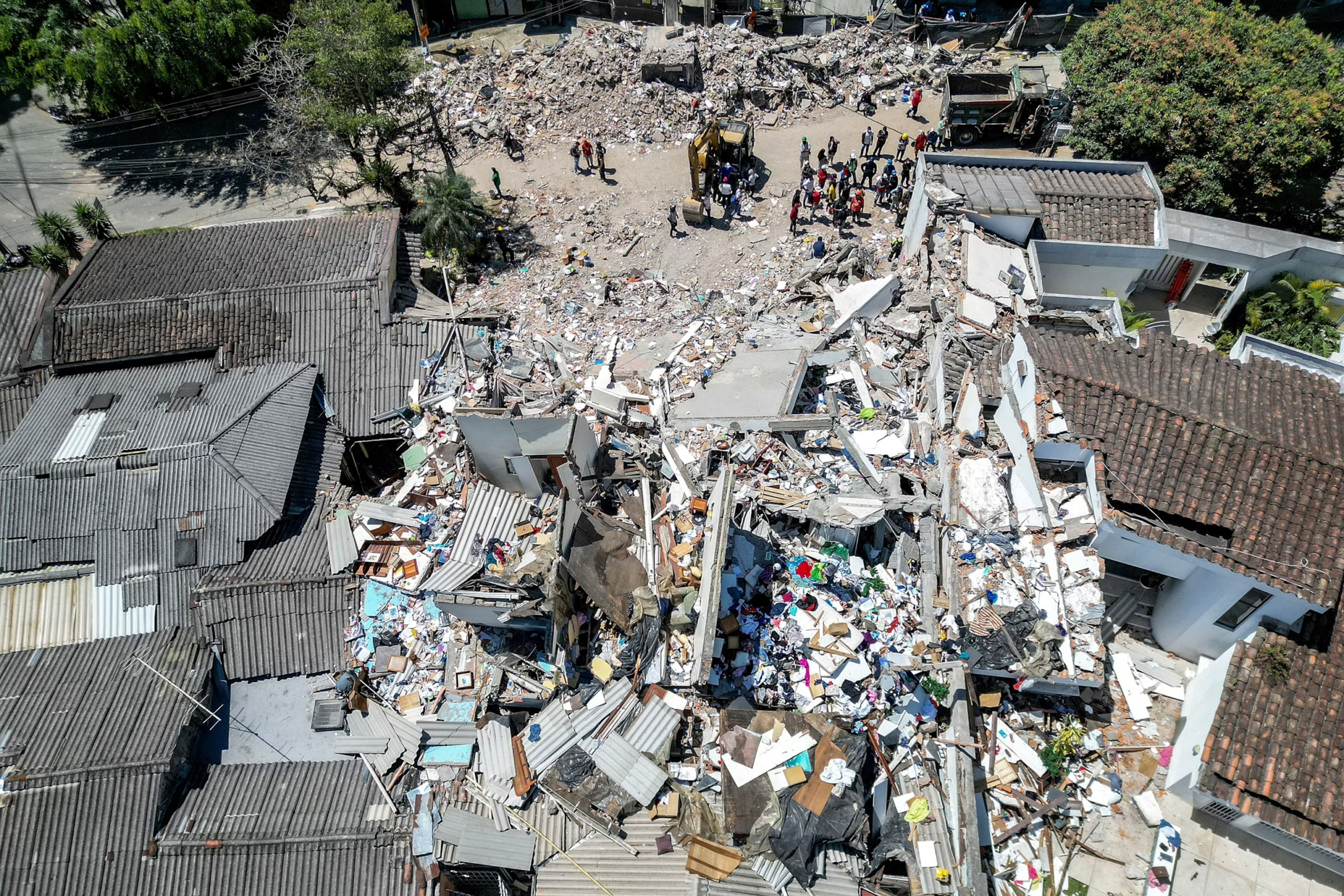
Image Credit: Luis Acosta / AFP via Getty Images, https://abcnews.com/International/colombia-earthquake-rescue-operations-continue-224-dead/story?id=135571163.
Editor’s Note: This essay was submitted as part of The Politic’s 2026 High School Essay Competition. The author, Martín Ramirez Pachón, is a senior at Colegio San José de las Vegas in Medellín, Antioquia, Colombia.
By the third bend of the San Juan River, the mud had swallowed Amparo López’s sandals to the ankle. She stepped from a narrow wooden canoe and followed a footpath into the trees. At the first house, sheets of corrugated metal sagged over a mattress soaked by rain. Farther uphill, a crack split the wall of a schoolroom where children had been studying days earlier. Plantain stalks lay flattened behind it. López opened the small notebook she carried against her chest and wrote down what remained: a family name, five people, one damaged home, food, roofing sheets. Then she closed it and kept walking. Another bend. Another settlement. Another name. The river carried her toward the next community. Seventy still remained.
At 7:34 a.m. on August 10, a magnitude 7.4 earthquake struck near San José del Palmar, Chocó, the strongest recorded in Colombia this century. The quake eventually affected 15 departments and, by August 21, the national government counted 284,185 people affected and 321 dead. Along the San Juan, however, López was helping build a different record. López, a community census coordinator with the Consejo Comunitario General del San Juan (ACADESAN), was helping document losses across the organization’s collective territory, which spans 72 Afro Colombian communities and is home to roughly 15,000 people.
“People did not come to us speaking in numbers,” López said in an interview. “They said, ‘My roof fell. My children are sleeping next door. The school is cracked. Write us down.’ So that is what we did.”
Writing a family down, however, is not the same as making that family official. Colombia’s National Unit for Disaster Risk Management (UNGRD) directs disaster victims to register through their municipal government in the Registro Único de Damnificados (RUD). Municipal disaster-risk coordinators, not community councils, enter those records into the national platform. The RUD is designed to identify and characterize victims so government agencies can determine the scale of an emergency and generate assistance.
“That distinction matters,” David Valencia, a municipal disaster-risk official in the San Juan basin, said in an interview. “A community can tell us that 40 families were affected, and that is essential information. But the RUD needs households identified individually. We have to verify the information and enter each case. In a place where getting to one community can take hours, that process does not happen at the speed people need.”
That structure also makes the bottleneck local. Under Colombia’s disaster-risk system, mayors are responsible for risk management in their jurisdictions, and municipal coordinators perform the registration that feeds the national database. A community authority may know within hours which houses along a tributary have fallen, but it cannot simply upload that knowledge into the RUD. The information must pass through a municipality that may itself be dealing with damaged offices, blocked routes, power failures, and hundreds or thousands of new cases.
The earthquake exposed the distance between those two systems of knowing. ACADESAN’s August 18 emergency report said the quake had shaken all 72 communities in its territory. Partial municipal reports cited by the organization documented more than 500 homes destroyed in Sipí and Litoral del San Juan and another 1,780 damaged in Nóvita and Istmina. Yet communications were intermittent, rain had cut access further, and some communities still had not reported their losses. ACADESAN mentioned that, eight days after the earthquake, it had received no official support to distribute among its communities.
The problem extended beyond one river. The Defensoría del Pueblo, Colombia’s human-rights ombudsman, identified censuses, registration of affected people, humanitarian assistance, and differential attention to ethnic communities among the unresolved needs it found after the earthquake. By August 16, its monitoring had recorded 77 reports of impacts on Indigenous and Afro Colombian communities, many involving damaged housing and community infrastructure. Mongabay Latam also reported that published national tallies did not disaggregate victims by ethnicity, even as Indigenous and Afro Colombian organizations produced their own counts.
For López, this parallel counting was not born on August 10.
“We have always had to know who is upriver, who moved, who came back, which family is missing, which community cannot travel,” she said. “The earthquake changed what we were counting, not why we count.”
That history matters in the San Juan, where geography and armed conflict have long complicated movement. Mongabay reported that community leaders trying to verify earthquake damage faced scarce fuel, weak connectivity, and restrictions linked to armed groups. These were not abstract obstacles. A list could stop moving because a boat could not. A family could remain outside a municipal count because the person carrying its information had not yet reached the office or signal needed to transmit it.
Valencia rejected the idea that the gap necessarily reflected indifference.
“The state is not waiting for perfect information before responding,” he said. “Aid has moved while the census is still open. But if we want recovery to be fair, we need a record we can defend household by household.”
The government’s response was substantial. By August 21, the Presidency reported that Colombia had received more than 220 tons of international aid and had moved from rescue toward temporary housing, health support, and early reconstruction. Those figures sit uneasily beside ACADESAN’s August 18 statement that it had not yet received official support to distribute. Both can be true: aid can reach a department before it reaches every community inside it.
That is where the two lists become consequential. Community records can move faster because they grow from relationships already embedded in the territory. Official records carry something different: the authority to convert a damaged roof, a displaced family, or an unusable school into a recognized claim on state resources. The weakness is not that one list is accurate and the other is not. Community councils cannot enter their counts directly into the RUD; municipal disaster-risk authorities must formalize the records.
López said ACADESAN had begun sending its information outward while continuing to gather it inward. Valencia said municipal teams were comparing community reports with the cases they could verify and enter. Neither process was finished. The most revealing finding was therefore not a numerical discrepancy, but a procedural one: the people who could identify losses fastest were not the people authorized to formalize them.
Near the end of her route, López reopened her notebook. One family she had recorded days earlier had finally appeared in the municipal system, she said. Others had not.
“I know they are there because I have sat with them,” López said. “The government will know them when the record reaches it.”
Then she turned to the next page. There were still names to add.
Sources
Primary Reporting
López, Amparo. Community census coordinator, Consejo Comunitario General del San Juan (ACADESAN). Interview with the author. August 20, 2026.
Valencia, David. Municipal disaster risk management coordinator, Municipality of Nóvita, Chocó. Interview with the author. August 19, 2026.
Documents and Reporting
Consejo Comunitario General del San Juan (ACADESAN). “Se agudiza la emergencia en el San Juan: al sismo se suma un vendaval, incremento de lluvias e inundaciones.” August 18, 2026. ACADESAN emergency report
Defensoría del Pueblo. “Pueblos indígenas y comunidades afrodescendientes enfrentan daños y necesidades urgentes tras el sismo.” August 17, 2026. Defensoría del Pueblo report
Rojas Hernández, Tatiana. “Terremoto en Colombia: pueblos indígenas y afrodescendientes hacen su propio censo de damnificados ante vacío de información oficial.” Mongabay Latam, August 21, 2026. Mongabay Latam investigation
Presidencia de la República de Colombia. “Balance de la respuesta y acciones del Gobierno Nacional durante la primera semana del terremoto en el occidente del país.” August 21, 2026. Presidencia de Colombia — government response balance
Servicio Geológico Colombiano. “Servicio Geológico Colombiano actualiza la información sobre el sismo ocurrido en San José del Palmar, Chocó.” August 10, 2026. Servicio Geológico Colombiano — official earthquake report
Unidad Nacional para la Gestión del Riesgo de Desastres (UNGRD). “Preguntas Frecuentes de la Gestión de Riesgo.” Sections on the Registro Único de Damnificados. UNGRD — Registro Único de Damnificados guidance