
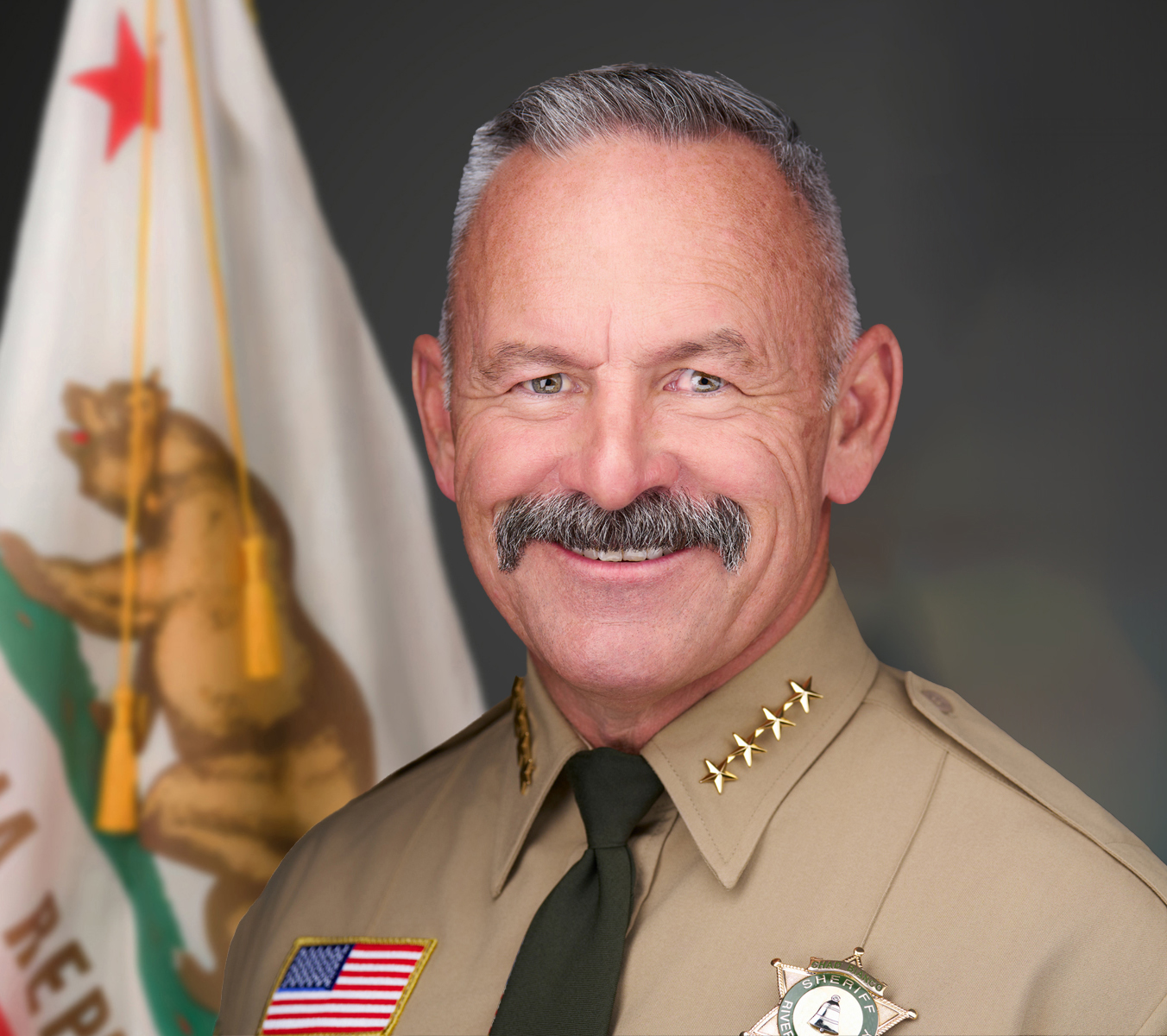
Sheriff Chad Bianco has spent more than three decades in the Riverside County Sheriff’s Department, rising from deputy to the county’s highest elected law enforcement office. In the 2026 California gubernatorial primary, he ran as a Republican in a crowded field against fellow Republican Steve Hilton and a slate of 60 other candidates. Bianco finished fourth with 10.2% of the vote, failing to advance; Hilton and Democrat Xavier Becerra took the two runoff spots.
Sheriff Bianco, you represent something rare in modern California politics—a politician who breaks from the establishment. In a state where Democrats hold a legislative supermajority and no Republican has won statewide office in nearly two decades, you face steep odds. What I’m struck by is that most people who feel the way you do about the state’s direction end up leaving. Being born in Utah, what drew you to the state? What kept you here? And when did you decide that it was worth staying and fighting for?
Growing up outside of California, when you’d see something on TV, or you’d hear something about California, there was always that “Oh my gosh, California.” I came here very early on in my life––I was 11 years old the first time, and I spent a week here. It was very obvious that I wanted to stay. There was nothing better than being here, coming from a very small town. I knew I was going to end up in California. I wanted to end up in California.
When I became an adult, I was 21 years old, and I thought, “Okay, what am I going to do? Let’s go to California.” It was to make something of myself, find a career, build a family. I find myself in California, and within weeks, I’m up putting a roof on a house. Within a year, I bought a house. That is not attainable today. No one can do that. You can’t go work for a roofing contractor and buy a house. That’s just in one generation––my kids don’t have that, but I did.
I had it in my head that there was a California dream—the lure of California— and my dream was to make it here—and I did. I worked hard. I found this career [in the sheriff’s department], and I was good at it.
No one wants to leave California. No one says, “I hate California, I’m leaving.” It’s [the] horrible politics. That’s why people are leaving. They’re tired of the taxes, or of the regulation, or of the cost of living, and they’re forced out. I don’t want them to force me out of my home. I love it here, and so I chose to fight for it.
You spent decades as a deputy before running for sheriff, first in 2014 and then in 2018. Was there a specific moment that made you think you needed to be the one making decisions?
At my core, I’m a public servant—I get joy from helping people. When I got to a managerial level, I realized that we weren’t doing that. We weren’t doing the most we could do to help people. It was bad policy and bad direction. It was a bad agenda. I realized that, as a manager, I could only influence the people right below me, but there were 12 other patrol stations and all these different things within our organization that I had no control over. I realized the only way to change something is from the top down.
I lost in 2014. I ran again in 2018 with the same message. Nothing had changed. But people had had enough. Winning then was my opportunity to show I could make major changes, and we did. We went from the brink of failure, where everyone wanted to leave, where everyone was leaving––between 35 and 40 deputies every two weeks. Now, I am fully staffed.
Shortly after 2019, I realized that I had to be in Sacramento, fighting the legislature and the governor, because there are bad policies being made.
We’re all fighting the same enemy, and the enemy is in Sacramento. The enemy is a state government that’s no longer working for us. It’s no longer working to make our lives better and easier. It’s making it almost impossible for every single industry. Ultimately, that’s what caused me to run—I knew something massive had to be done in this state for public safety, and with taxes and business regulations. I can be as loud as I want [but] you have to be the governor to make that change. It eventually comes to the point of: if not you, then who? We do this, and we’re gonna do everything we can to save our beautiful state.
You sit at this interesting political geography, working in Riverside County. What have you learned about governing and earning the trust across that kind of mixed electorate in Riverside? How has it influenced your campaign, and how would it influence how you approach the governorship?
What I did here is exactly how I approached the campaign, and it would be exactly how I’d be as governor—and it’s not for politics. It’s to make people’s lives better outside of politics. In my career, I’ve never only helped people who voted the same way I did. You help everyone, and that is the makeup of my being. You look at law enforcement—the majority of people that we help don’t even like us, but we still go out, and we help them.
I will never be the typical politician. When we talk about a politician, there’s not a favorable impression, because we believe that they cheat, we believe that they lie – we can’t trust them. I represent something completely different from that. I don’t want to be a Republican—that’s not who I am. I’m the Sheriff of Riverside County. I’m a husband, a dad, a grandpa. I have beliefs, I have values, I have ethics, I have morals. That’s who I am. I want you to elect me because of who I am and what I’m going to do for your state, not because I belong to your party or anything else.
That normal person outside of politics—that’s what people are looking for—someone that they can trust. Being the sheriff offers that automatically. We’re held in high regard by most people: we’re the highest elected official in our county, and that respect comes with that. Some people don’t like me right now, even in Riverside County, not because I’m the sheriff and what I’m doing—it’s only because I’m a Republican.
I’ve said for a long time, way before 2019, when I took over: the only way we are going to fix the situation we find ourselves in is when we quit voting for parties. We have to take the D’s and the R’s and the NPPs off the ballots, and we have to start looking at who we’re voting for. We have to vote for character, integrity, honesty, leadership, and ethics. We don’t have that now. I say all the time: if Charles Manson was the only Democrat on the ballot in California, people would vote for him only because he’s a Democrat—and that’s wrong.
Talking about the identity of Republicans and the identity of Democrats, particularly on college campuses, right now, there is this energy that it can be very socially costly to identify yourself as conservative. Do you think that the Republican Party has ceded this space—the university space and the higher education space—for this identity conversation? And is there a version of what you’re offering that doesn’t really require somebody to fully identify with the national conservative label to be interested in your campaign?
I think that everything my campaign represents aligns perfectly with that. I think the problem that we have on college campuses, the problem we have in politics, is the political violence that is being perpetrated by those in power, those politicians in power, for their own benefit. You can’t identify as a Republican on a college campus because you’re going to be completely attacked, you’re going to be completely shunned, and you’re going to be called names—they don’t even know who you are, but, “Oh my god, you’re a Republican, you’re the devil, you fascist, you racist,” all of these things. And as a good person, you don’t want people thinking that. So you just remain quiet, and go along with the flow, and you don’t tell people what you really believe, and you just side with them because you’re afraid of the violence that is going to come to you. That’s how we’re going to lose our country.
We should not be allowing this, and unfortunately, our colleges are a hotbed for it. It’s just become accepted that our schools, our universities, are liberal. Why did we make that okay, and why did we allow that to happen? What is being taught in our schools and pushed into our kids’ heads is not to think for themselves. You’re just being told what to believe, and you’re being criticized, called names, and violence is used against you if you don’t go along with them. We’re in a bad, bad spot because we’re allowing that to happen. It’s death by 1,000 razor blades. You look back and think, “Oh my gosh, what happened? How did we get here?”
Conservatives, Republicans, Libertarians, and anybody else are not being represented in California at all. They couldn’t care less about you. They don’t have to, because they have a supermajority of Democrats in Sacramento—that’s why California is broken. My campaign is not saying I’m a Republican and I’m going to go in and change all the conservative opinions and conservative values. Rather, I’m going to make life easier for you; I’m going to make the California government work for all of you—for all of us—outside of who you vote for. I don’t have a different opinion of you because you vote differently from me. I’m still going to take care of you.
The federal government has moved to cut funding to certain academic institutions. As governor, how would you approach funding for public, private, and community colleges — and how do you think about protecting intellectual openness on campus without simply replacing one orthodoxy with another?
We have to be completely honest about what the problem even is. Of course, they’re blaming the federal government, saying the federal government’s cutting off funding. The school still blocks conservatives from having a voice on campus, and the school still blocks conservative speakers. I was blocked from going to a campus to speak to kids. How does that happen? How else do you want them to respond?
As governor, that’s exactly how I’m going to respond. The people who are running these colleges and universities are running them to politically influence you, not to educate you, not to teach you how to be productive, not to teach you how to think. You may get lucky and have one professor who does.
Why would I fund that? I will do that as governor—I will cut off all your funding. I’m not going to give you funding to politically motivate people. Your job as a university, as a college—whether it’s a junior college or up to a state university or a private university—your job is to educate kids. Your job is to provide them with the tools they need to get into the career they want to,, teach them how to learn, teach them how to research, teach them discernment, teach them about failure, teach them how to overcome failure, and navigate to success. That’s not what’s happening in school.
Why would I use taxpayer money to fund that? I will fund the schools that are going to teach kids how to be effective. I remember fantastic professors who would question everything.
We’re just going in the wrong direction. It would be my role as governor to make sure that we’re getting the best for everyone. You’re not teaching a bunch of robots; you’re teaching a bunch of individual minds to be able to think for themselves—and teaching them to argue their political beliefs as I’m capable of arguing my political beliefs—but we should have learned how to do that in an environment that didn’t create animosity. You get to a point where we agree on 90% of things, but now we hate each other because I’m right and you’re wrong on this one issue. We’re teaching political identity in our schools, and I don’t agree with that.
How do you plan on protecting the 21- to 22-year-old college graduate—and non-college graduates in trade professions and other career paths within the state—who really want to stay where they grew up? What’s your approach to that demographic?
I want everyone to stay here. You’re here for a reason. If you choose that you want to get away from your family, or maybe you want snow, and you feel that another state is your state that you have to go to—fine. But I don’t want anybody leaving because it’s cheaper somewhere else, because this state takes too much of my income taxes, because they can’t open a business because it’s too hard here. I don’t want my kids and my grandkids leaving because they can’t afford an apartment.
I want the opportunity to be available to everyone for you to stay. The reason why people are leaving California is that they can’t afford to live here. They want to open a business, but it’s too hard. They want to build a house, but it’s too expensive. All of those things are government-caused. Those are not caused by the 20-year-old. The 20-year-old inherited this mess that was given to them by the last 20 years of bad politics, and we can take it away.
We have to be big enough as adults to say we did this. If you look all across the country, when a state has a net loss of population, they panic—they try to figure out what happened, they try to reverse it. That’s not what California does. California celebrates it. Six years in a row, we’ve lost population. I want your parents to know that you’re just down the street, and their kids, or their grandkids, are just down the street. I want them to know that they don’t have to take a flight to go see you. I want you to be able to open a business here. I want there to be so many businesses and jobs here that when you get out of college, you can go work anywhere you want.
My California dream has been taken away from millions of kids. There are no kids in the rest of the country saying, “Man, if I could just move to California, my life would be so much better.” I want it to be natural that you’re just going to stay here.
Speaking to this California reputation, the supermajority in Sacramento—there’s this attitude that California has already made up its mind. The conventional wisdom is that a Republican, a conservative, or a non-political candidate can’t really win here. There’s also this attitude that campaigns like yours are more of a statement. You’ve clearly rejected that framing, but I want to ask you: what does it actually feel like to be the person making this bet on the state, on the voters, on the idea that the conversation is a lot more open than we let on?
That’s a deep question. It’s been a very hopeful campaign. It’s been a very disappointing campaign. Everything you can think of is wrapped into this campaign. The idea that someone like me can’t win is a psychological warfare game that has been played on us for a long, long time—40 years, 50 years, 60 years—and we have been convinced in California that a Republican can’t win. We have been convinced that a person like me can’t win in California, so there’s no point in even supporting him. “Don’t vote for them, because they can’t win.” What we know has happened is that mentality has caused the majority of our state to not even participate in the political process. They believe it’s not going to matter, and when you’ve been psychologically convinced that nothing you do is going to matter, then nothing’s going to matter.
That’s really where we are. When I travel and talk to people my age and older than me who have never voted before, it’s very disheartening. Sometimes Denise [Bianco’s wife] and I talk, and it’s like, why am I doing this? Why am I putting our family and us out there to the hatred, the ugliness, and everything else that’s coming at us? Why am I doing this for California when 60% of the state isn’t even going to vote?
But then there are those people who are losing their businesses—a sixth-generation farmer whose kids are going to lose it when they die because they can’t afford it, or the taxes are going to take it away. When I listen to them and I hear that emotion—that’s why I’m doing it. That’s what keeps me going, even though I get in rooms sometimes where half of these people aren’t even going to vote—not that they aren’t going to vote for me; they’re not going to vote at all. It’s an emotionally taxing thing to run, especially outside of that part where everyone says you can’t do it.
If I were a Democrat and I approached this saying the same things that I’m saying now, people would say, “Hey, he might win.” But I’m a Republican, so it’s, “No, he’ll never win. The poll says he’s not going to win.” And that’s psychological too.
In the political world, in running a campaign, a poll is either to get your money or your vote—that’s it. It’s not real; it has nothing to do with reality. You ask questions to get a certain answer. Polls aren’t generic. Polls aren’t organic. And then psychologically, why would you vote for the person at the bottom when the person at the top is going to win, because everybody’s telling you they’re going to win? Someone else picked that winner for you.
On your question of making a statement—that my campaign is more of a statement—maybe it is; I don’t know. What I offered the voters of California was by far a better California than any of the people that are running with me, and if I don’t win, they either weren’t listening, they didn’t want it, or they didn’t vote. We won’t know until it’s over.