
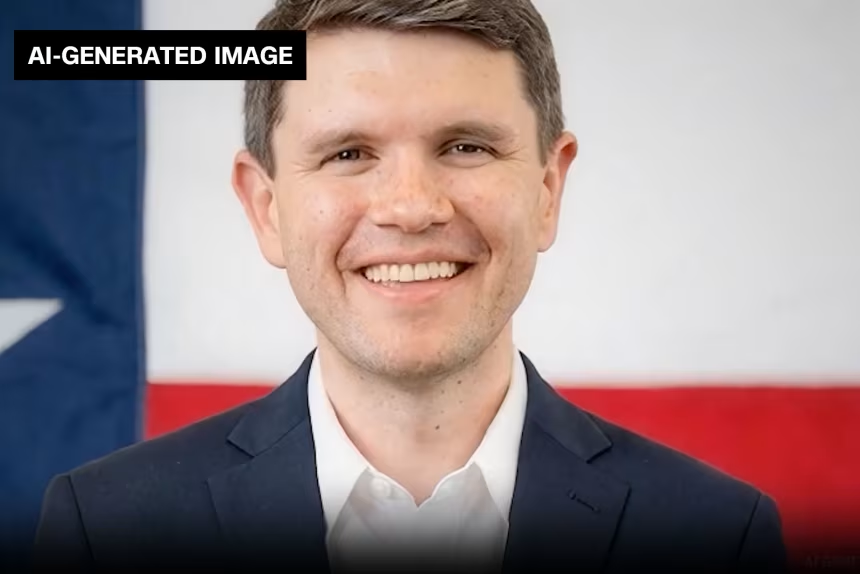
Photo: A deepfake of Democratic candidate for U.S. Senate for Texas, James Talarico, as generated by the National Republican Senatorial Committee. National Republican Senatorial Committee on X.
In September 2004, just two months before President George W. Bush’s reelection bid, 60 Minutes aired a segment alleging his corruption. The news organization had obtained documents drafted by Bush’s commander, Lieutenant Colonel Jerry B. Killian, indicating that Bush received preferential treatment while serving in the Texas Air National Guard. The documents were soon exposed by typography experts as forgeries.
Before the age of artificial intelligence, these were the types of deepfakes that confounded the public. Now, advancements in technology have made such material dangerously prevalent, intricate, and more convincing than ever before. A recent National Republican Senatorial Committee ad featured a deepfake of Texas candidate James Talarico reading old tweets out loud. President Donald Trump came under fire in February for posting an AI-generated video reimagining the Gaza Strip as a beach resort. Democrats, too, have employed deepfakes; in December, California Governor Gavin Newsom posted a video showing Trump and top administration officials crying in handcuffs. As new technologies evolve faster than the legal system can pass targeted legislation, courts have been forced to rely on common law regarding free speech and defamation.
The Cycle of Tech
The problems that AI generates are “nothing really new,” according to Eugene Volokh, a First Amendment scholar and Distinguished Professor of Law Emeritus at UCLA. “It’s the kind of thing that has happened before. Deceptive material in political campaigns has long been around. I think the legal regime is the same here, or ought to be the same here, for AI output as for non-AI output.”
Volokh is among many legal experts who treat AI as an iteration of previous controversial questions about free speech. Deepfakes, misinformation, parody—“we’ve seen it all before,” he says.
Isabelle Anzabi, a research associate at The Future of Free Speech, agrees with Volokh. “Looking into it now, this has been a cyclical thing,” said Anzabi. “But a lot of the focus on AI now is kind of what we saw in the past with focus on misinformation and disinformation.”
If AI is just an accelerated version of previous digital issues, does it suggest a need for new legislation? “Rather than immediately rush to pass new legislation,” Jennifer Huddleston, a senior fellow in technology policy at the Cato Institute, said, “I think a better method is to look at existing laws.” Huddleston fears that implementing new legislation could violate free expression by inadvertently stymying important political discourse or commentary, as well as outlawing obvious AI-generated parodies. Anzabi agreed, stating that “it is super important that any regulation continues to respect free expression.” A compelling alternative, Huddleston suggested, is to treat the issue from an industry perspective, allowing companies themselves to create new standards as issues arise.
Battling the Tech Industry
Companies rarely seem eager to implement regulations that limit their ability to profit and stay ahead in the fast-evolving world of tech innovation. “It is a resounding no in terms of whether the tech companies are regulating themselves properly,” said Mary Anne Franks, President of the Cyber Civil Rights Initiative (CCRI) and Professor of Law at George Washington University. While the First Amendment and other precedents can be used to regulate AI, their efficacy is limited. “We need to make laws really explicit because right now it seems clear that the bad actors are not being deterred by existing abstract theories,” asserted Franks.
Some organizations have turned to public education as an alternative solution. “If we just want people to be able to distinguish between AI and non-AI outputs, maybe public education is where we want to put most of our efforts,” Franks affirmed. “But if we’re trying to stop exploitation, impersonation, and abuse, then it’s certainly not enough to educate the public about seeing what’s fake and what’s not. That’s not responsive to the underlying injury.”
Meetali Jain, director and founder of the Tech Justice Law Project, has spent recent years going head-to-head with tech companies and litigating the unique ramifications of AI. In 2024, she began representing a woman named Megan Garcia, whose teenage son committed suicide after months of exchanging romantic, explicit messages with a chatbot. Garcia said the chatbot groomed her son and encouraged him to kill himself. She went on to sue Character.ai. For Jain, these granular cases are indicators of a larger erosion.
“It’s about scale,” Jain said. “In these cases, we’ve been talking about individual harm. But to me, that’s just kind of a precursor for what’s possible with society at large.”
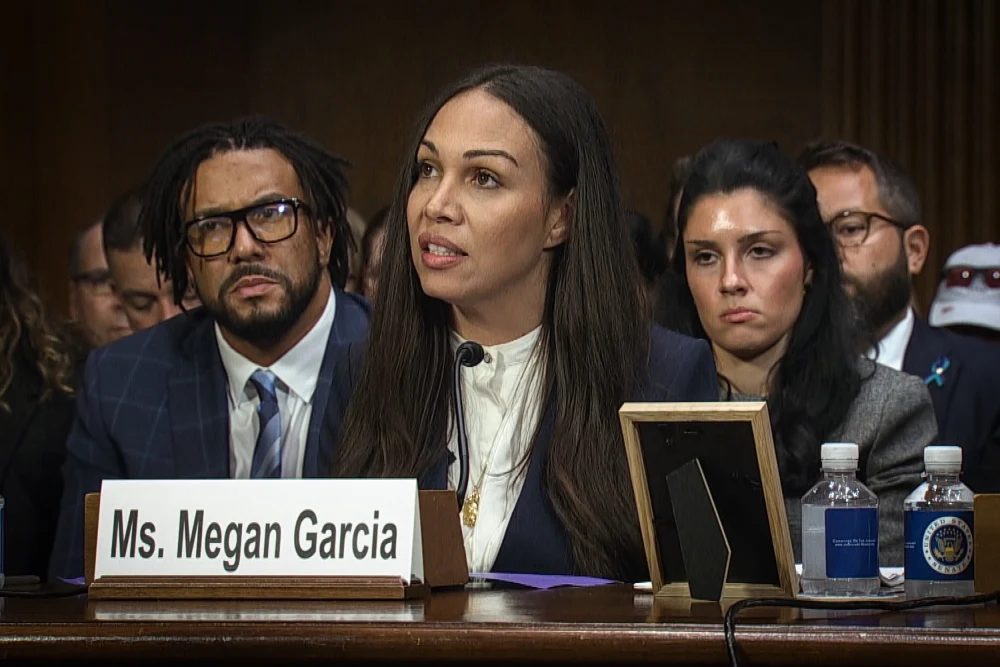
Photo: Megan Garcia testifies to Congress during a hearing about AI on September 16, 2025. Source: NBC News.
Unlike Huddleston, Jain believes that AI has presented history with a unique circumstance that must be addressed through new legislation. However, faced with the slow pace and complexity of passing new laws, Jain has shifted her focus to litigating cases like that of Megan Garcia. Beyond facing some of the biggest names in AI—such as OpenAI’s Sam Altman—Jain has also investigated cases of AI in the political sphere that go far beyond political deepfakes.
In the past few months, the Pentagon sought to purchase a licensing agreement for Anthropic’s AI models. At first, officials agreed to several red-line stipulations, but eventually the Pentagon began pushing for an agreement that would allow for unrestricted use of Claude. Though the deal fell through, Anthropic’s AI models were already embedded in the Pentagon’s systems and were most recently used to carry out strikes against Iran.
Jain’s company filed an amicus brief—a legal document experts can submit if they have interest in a pending case—against Anthropic. The Tech Justice Law project alleged that, even though the company eventually withdrew from the deal, Anthropic knowingly allowed its technology to be used recklessly by the current administration. In going after the AI company, the Tech Justice Law Project faced organizations such as the American Civil Liberties Union (ACLU), placing them in a now-familiar stand-off between safety advocates and free speech advocates. The former believe AI should be more restricted, especially in a military context, while the latter argue that most restrictions infringe on First Amendment rights. This leads to complicated discourse around cases such as the Anthropic lawsuit, which is unusual in that the AI company ultimately severed ties with its government users.
“A lot of people that were coming out with amicus briefs were doing so in support of Anthropic and furthering this narrative that Anthropic was somehow the good guy here,” Jain explained. “But the truth is, Anthropic very willingly went into partnership with the U.S. government well before this incident to offer its AI for military use. And our view is that generative AI is so dangerous that it should not be deployed militarily without thinking about the possible ramifications.”
Jain, like Professor Franks, is worried about the consequences of America’s political elite becoming increasingly entangled with the CEOs of tech and AI companies, from Elon Musk to Mark Zuckerberg. “It’s like the fox is guarding the hen house,” Jain said. “There’s just no separation of powers, because we have the heads of these AI companies really dictating to our lawmakers through their corporate donations.”
In response to the argument that regulating AI could infringe on free speech rights—either users’ or those of the companies themselves—Jain related an anecdote from her time spent clerking for a judge in South Africa. Upon learning that Jain was American, the judge pulled her aside and told her that South Africa deliberately decided not to make free speech absolute. Rather, they treat it as a value and a freedom that is contextual and balanced against other liberties. Jain believes we should take that framework to heart, placing AI in a legal context that prioritizes other factors beyond unqualified free speech.
“He said, ‘we understand the dangers of an absolutist version of free speech,’” Jain recounted. “‘You know, it’s called apartheid.’”
What’s next for AI?
When asked about the future of AI, experts had a wide range of answers.
Volokh believes it is too soon to know what the future of AI holds. “Mass use of AI is new,” he said. “Its use in politics is newer still. This is something we’re going to have to wait and see,” he added.
Franks worries that we are past the point of being able to address AI as it becomes increasingly pervasive. “I fear that we’re not going to meet the moment,” she added. “Or maybe we had the moment, and we kept missing it, and now it’s really difficult to put that genie back in the bottle.”
Jain believes that this pervasiveness has infiltrated society, becoming emblematic of AI’s impact through even the most intimate of cases. While the AI debate is often inflated to national and international issues, Jain looks to the Garcia case to show how AI’s consequences are tragically personal. While Garcia settled the lawsuit in January 2026, the emotional scars of losing her son Sewell will abide. And while Character.ai has put new safety regulations in place, it remains to be seen whether this will be enough.
Garcia was the first person in the United States to file a wrongful death lawsuit against an AI company, but she was not the last. Since then, four other families joined her lawsuit to sue Character.AI over harm they allege their children suffered.
“Whether it’s peeling off people one by one or it’s engaging in a mass genocide of a lot of people at once…,” Jain trailed off. “I mean, it’s just death by a thousand cuts, really.”