Generation after generation, Janet Henry’s family has called New Orleans home: her mother, grandmother, and great-grandmother were all born there. “People are born there, live there, and die there,” the Yale junior said.
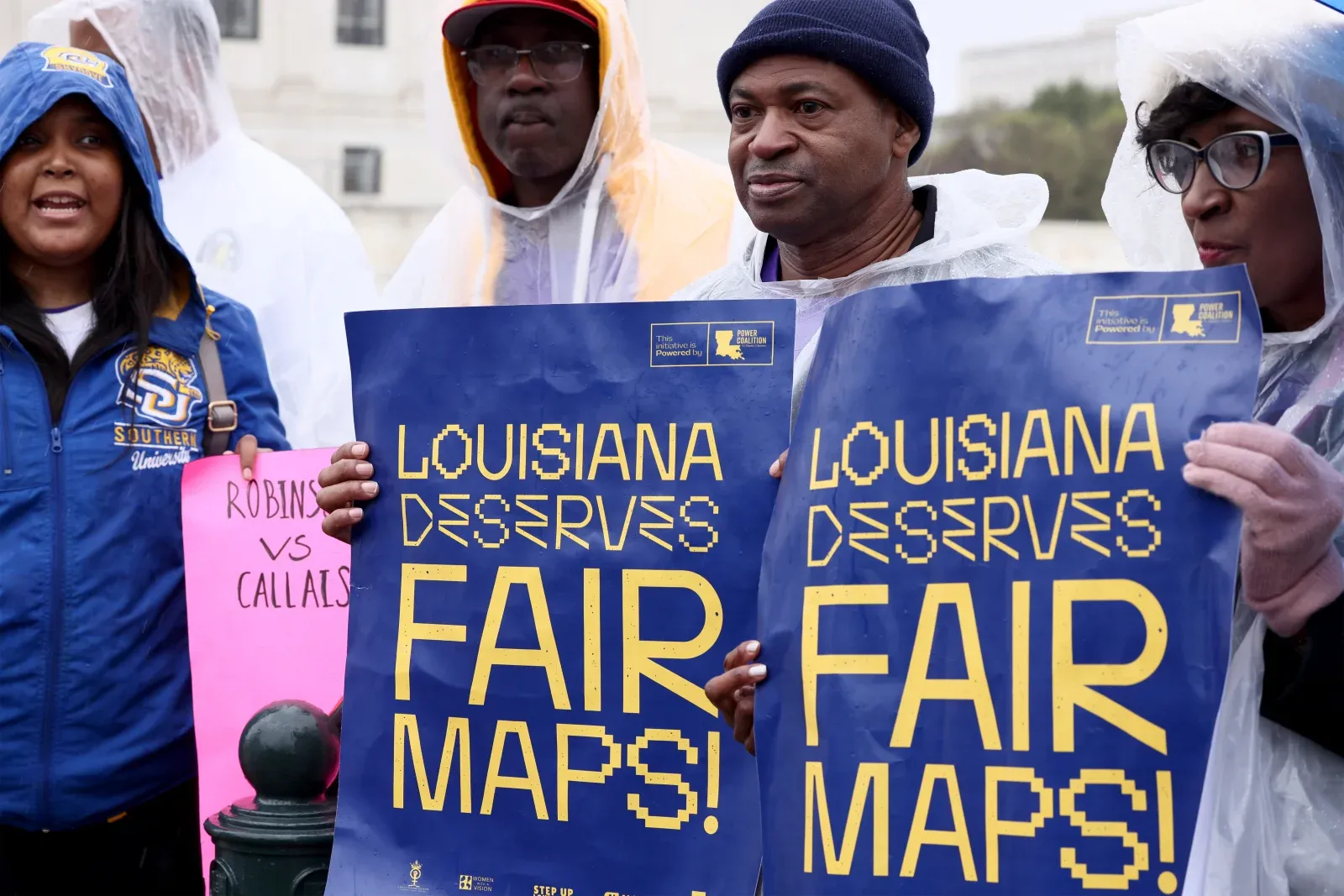
Many Black Americans can similarly trace their roots to the American South, where 57% of the U.S. Black population currently resides. Black American families that have generationally lived in the South have faced many economic and social barriers that have challenged their right to vote. The most recent development in this struggle came on April 29, 2026, when the Supreme Court ruled in Louisiana v. Callais to eliminate Louisiana’s second majority-Black district.
The decision marks a paradigm shift in Black Louisianians' power to control their future. Demographics, geographical lines, and race have become integral to deciding how Black Louisianians will be represented in Congress, and even the extent to which the Voting Rights Act (VRA) protects marginalized U.S. voters moving forward.
In 2022, Louisiana state legislators drew an electoral map that included just one majority-Black district out of six. The new map surprised many, as the ratio seemed disproportionate to a state population that is one-third Black . In response, backlash over the map's constitutionality led civil rights groups and community members to sue . A federal court subsequently ordered Louisiana to adopt a new congressional map with two majority-Black districts to better reflect the state’s population demographics in Robinson v. Ardoin . The legislature later passed this revised map through Senate Bill 8 (SB8) in 2024.
The legal battle was far from over, though. Phillip Callais, a white resident of Louisiana’s newly created 6th District, voiced his dissent over the Robinson v. Aridon decision, claiming that the new map was an unconstitutional racial gerrymander that violated the 14th and 15th Amendments. He and other critics of SB8 joined Callais v. Landry (2024) against Louisiana Secretary of State Nancy Landry, where a divided three-judge panel ultimately sided with Callais. As a result, the 2024 map—established under Robinson —was replaced with one that reflected the composition of the map drawn in 2022, eliminating Louisiana’s second majority-black congressional district.
In Louisiana v. Callais (2026), the Supreme Court upheld the state’s decision, ruling 6-3 that the 2024 map was unconstitutional under the 14th Amendment. As a result, Louisiana’s 6th district, which included the predominantly Black cities of Baton Rouge and Shreveport, was eliminated. The new boundaries would allow Louisiana Republicans to control five of the state’s six congressional districts.
In response, many voting rights activists, legal scholars, politicians, and voters worry about Callais's future implications, believing it will negatively affect minority representation in Congress.
Richard Pildes, an election law scholar at New York University, argued voting rights cases before the Supreme Court such as Alabama Democratic Conference v. Alabama (2015) and Rucho v. Common Cause (2019). He described how Callais will change how courts understand racially polarized voting going forward.
“Plaintiffs will now have to show that partisanship does not better explain differences in Black and white voting patterns,” Pildes said. “For example, if Black and white voters support Democratic and Republican candidates at similar rates, regardless of the candidates’ race, it becomes harder to establish that race is driving those patterns.” In other words, voting rights plaintiffs will now have to show that a state drew a map with intent to racially discriminate rather than a map resulting in racial discrimination.
Justin Levitt, a constitutional law scholar and former Deputy Assistant Attorney General in the Civil Rights Division of the Department of Justice, adds that “now, in any state that allows the use of partisanship, it’s going to be effectively impossible because Callais requires that you draw a map that satisfies the legislature’s partisan priorities and all of their other non-racial priorities.”
Justin Levitt, a constitutional law scholar and former Deputy Assistant Attorney General in the Civil Rights Division of the Department of Justice, adds that “now, in any state that allows the use of partisanship, it’s going to be effectively impossible because Callais requires that you draw a map that satisfies the legislature’s partisan priorities and all of their other non-racial priorities.”
Levitt also emphasized that Callais almost entirely guts Section 2 of the Voting Rights Act (VRA), which he described as a “really powerful mechanism to force legislators to give an equitable opportunity to communities of color, even when they didn’t want to.” Hence, the Callais decision threatens to eliminate those protections that have shielded historically marginalized communities against attempts to restrict their voting power.
Across time, Black American voters have experienced their fair share of impediments. Prior to the VRA, many states, including Louisiana, implemented literacy tests, poll taxes, and Grandfather Clauses that significantly reduced the number of eligible Black voters. Black voters and activists fought for decades following Reconstruction to challenge voter disenfranchisement and suppression, and were often faced with violent opposition from law enforcement agencies and White supremacists. The Callais decision creates a new set of challenges for Black voters, which many view as a major setback.
Representative Troy Carter of Louisiana’s 2nd District, now the only majority-Black district in the state, described, “When you go into communities of interest…and you summarily crack them and divide them apart, you dilute their voting strength,” he said. “You dilute their ability to vote in bloc, [and] their right to vote for the person of their choice.” In other words, Carter explained that this creates a paradox in a representative democracy, where some communities are deprived of representation.
As a result of Callais , Black citizens in Baton Rouge are now divided between two districts, one of which is Carter’s. Meanwhile, residents of Shreveport are now a part of the Northwestern Louisiana district. The elimination of the second majority-Black district could significantly reduce Black voters’ opportunities to elect their preferred candidates.
Keturah Butler-Reed, a student from Baton Rouge and the National Training and Campaign Manager of the NAACP Youth and College Division, elaborated on the effects Callais has on representation of specific political interests in Black communities. “When I think about redistricting, it's always about representation and resources,” she said. “These are the people who are determining the resources that are going to our schools, our highways, our hospitals, etc. When you take away representation, you take away our ability to elect [representatives who] understand our plight, then you take away our ability to survive.”
“These are the people who are determining the resources that are going to our schools, our highways, our hospitals, etc. When you take away representation, you take away our ability to elect [representatives who] understand our plight, then you take away our ability to survive.”
Butler-Reed described what issues are particularly at stake in Louisiana. She expressed specific concern for Black women’s reproductive rights and maternal rights. “So many Black women are dying because of the infrastructure that we have, [and] how we are ranked the lowest in things like economy and education consistently throughout the years,” Butler-Reed said. “These are all issues that end up on the ballot box, whether it be [in] amendments or through the representatives that have a choice to advocate for the people that live in their state.”
Hence, constituents like Henry have expressed concerns about how Black residents across the state will receive proper educational resources with only one majority-Black district.
“Who do we talk to about our future if everyone now has so many other people that they need to cater to and pay attention to as well?” she asked. “Education is one of those things that really quickly gets swept under the rug and often gets put on a back burner.”
She explained that after Hurricane Katrina devastated New Orleans in 2005, education was in permanent limbo. According to Henry, historically prominent high schools have only recently recovered.
Henry also described how losing a district could discourage Black voters from turning up at the ballot box.
“The quality of their vote doesn't really matter because they're in a district that's mostly wealthy and/or mostly politically divided,” she said. “Even if they do vote, it won't matter because the white [voters] make up so much [of the population].”
Carter affirmed this idea. “When you have people looking, and they see that a legislature can just get together with a majority vote, wipe away African American representation, and have it supported by the highest court in the land, it's discouraging,” he said.
Beyond the social consequences of Callais , there are also severe legal ones. Nicholas Stephanopoulos, a constitutional law scholar and director of strategy at the Harvard Law School Election Law Clinic, described the potential legal consequences.
“There are lots and lots of districts around the country that people thought were protected by the Voting Rights Act, and now most or all of those districts can just be eliminated if that’s what states want to do,” Stephanopoulos said. “Before the 2028 election or other future elections, we’re going to see a lot more redistricting like this, where places that see some political advantage in getting rid of Black-majority districts will just do that.”
He then explained how Black representation has not declined substantially in the South since post-Reconstruction days, and that Callais may open the door to a major downturn in minority representation.
Naifeh explained some of the immediate effects on majority-Black districts in the South. “The reasoning in Callais has already eliminated a Black opportunity district in Alabama,” he said. “We saw legislatures in Georgia, Mississippi, and South Carolina considering changes to their maps. They didn’t move forward with that [this] cycle, but they may well move forward with that next cycle.”
Naifeh then emphasized that even states that do not wish to change their districts may be sued by groups of voters similar to those in Callais who want to eliminate their districts for a 14th Amendment Equal Protection Clause violation.
Despite the impacts of Callais , Carter still encourages continued civic engagement and advocacy. He and his legislative team have spent extensive time traveling throughout Louisiana to debunk the myth that one’s vote is unimportant.
He shared a final piece of encouragement for his constituents.
“We're not going to quit,” Carter said. “We have to fight injustice wherever it is, because injustice against one group becomes injustice against every group.”
“We're not going to quit,” Carter said. “We have to fight injustice wherever it is, because injustice against one group becomes injustice against every group.”
It is with this same determination that Janet Henry concludes, “I definitely think that there is hope to have more Black political representation, specifically in Louisiana. It benefits the local population and the state as a whole.”
Ultimately, Louisiana's congressional boundaries may continue to be redrawn; yet the fight for equitable representation extends far beyond the lines on a map.