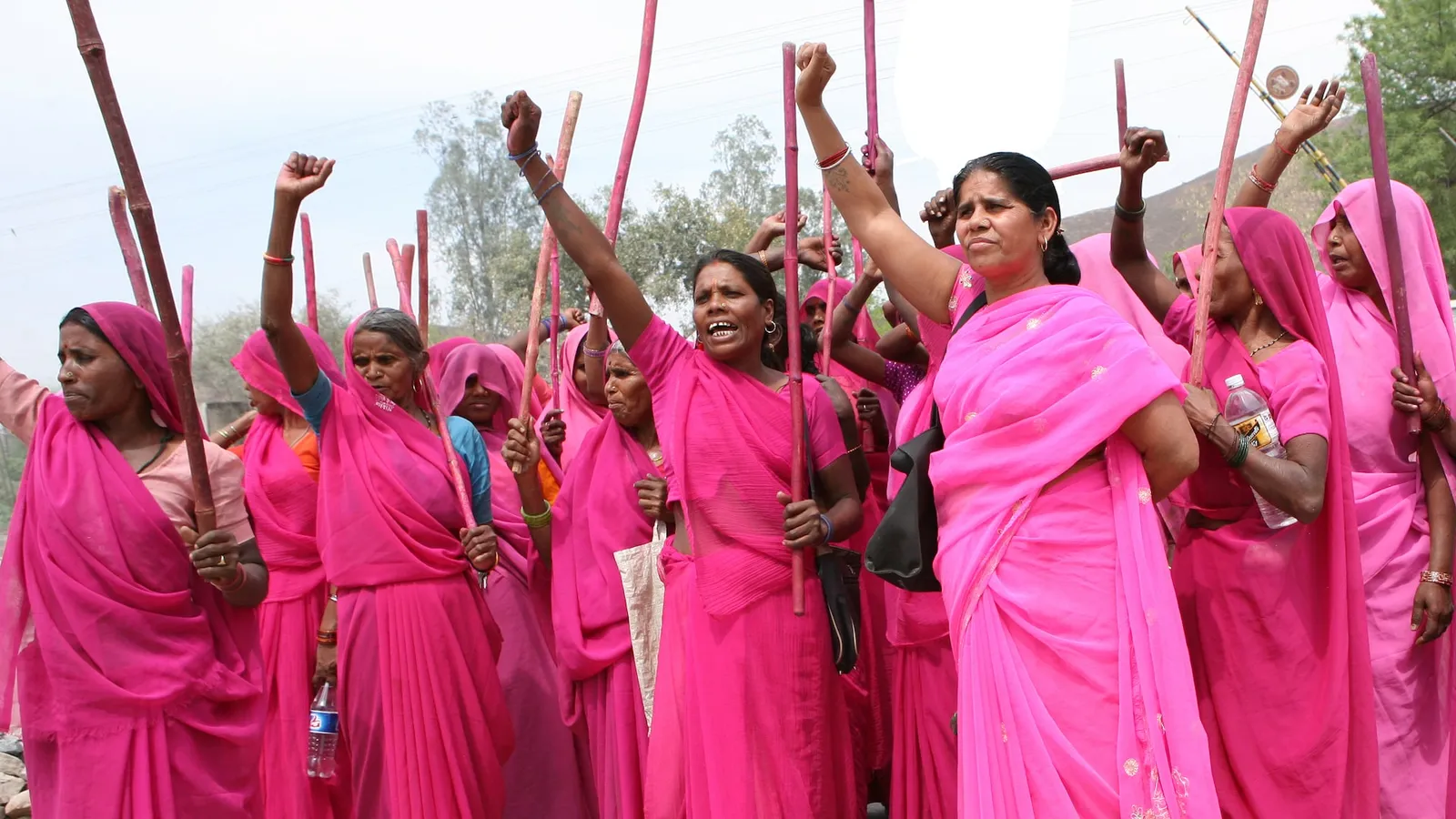
Sampat Pal (far right, fist raised) leads a Gulabi Gang protest.
Photo: Kudos Family/Torstein Grude
Sampat Pal is the founder of the Gulabi Gang , Hindi for “Pink Gang,” a women’s movement she started in 2006. The Gulabi Gang began in the Banda district, Uttar Pradesh, located in the Bundelkhand region of northern India, one of the country’s poorest and least developed areas . She says the movement now counts 1.1 million women across seven states. The movement’s members wear pink saris, carry lathis [bamboo sticks], and take up cases of domestic violence, dowry, and child marriage, along with local issues, often by confronting police and local officials. Pal was married at 12 and never went to school. Her memoir, Moi, Sampat Pal, chef de gang en sari rose , was published in France in 2008. In 2012, she ran for the Uttar Pradesh assembly as a candidate for the Indian National Congress Party, finishing fourth with 23,003 votes , 20,815 behind the winner, Chandrabhan Singh Patel of the Bahujan Samaj Party. One of her pink saris was shown in The Offbeat Sari at London’s Design Museum in 2023. Pal continues her work under the Gulabi Gang name.
This interview was conducted in Hindi and has been translated and edited for length and clarity.
When a woman comes to you for help, how do you handle her case?
We run a large organization and do difficult work that often challenges the administration. The government does not give us anything, and we do not take anything from the government. I feel that if we accept something from them, they will make us their slaves. We have not taken money from the government, middlemen, or contractors.
Our work runs on donations. We make our position clear: if someone makes a documentary about us or writes about us in a magazine, we ask for a donation. Some people see our work and give happily. That is how the organization runs.
We work on dowry, child marriage, and education. There is a great deal of discrimination here. If a girl and a boy choose each other, people oppose them and bring cases against them. I tell girls to study first, earn their own living, and reach adulthood. Then I support their right to marry the person they choose.
If a husband drinks and beats his wife, I first go to the police station and say that this is a legal matter and something has to be done. Earlier, the police did not listen to me. Now they listen much more.
There is a woman whose husband, a lekhpal [a local revenue official], threw her out of their home. She had no income of her own and had been staying at her parents’ home for four years. She struggled and eventually came to us. We tried explaining things to her husband. We went to the police and to the district magistrate. Then I took about 100 to 150 women, and we surrounded the collector’s office. Now, I think they will call her in and listen to her case.
These things do not always get resolved simply by asking. We try talking first. If they do not listen, we have sticks in our hands. “Do the work, and we will talk; otherwise, we will use the stick.” That is our slogan.
We try talking first. If they do not listen, we have sticks in our hands.
Can you tell us the story of how the Gulabi Gang was founded?
I live in Uttar Pradesh, in the Bundelkhand region. Bundelkhand is a land of brave people; the Rani of Jhansi came from here, a queen and major leader of the Indian Rebellion of 1857 against British colonial rule. She was so courageous, but ordinary women here were still bound by old traditions. I don’t know where that energy came from in me, but I began working for women’s rights.
The Gulabi Gang was formed in 2006, but I had been doing this work long before that, since I was about 20. I am now over 60. I went from village to village bringing women together. At first there were three of us, then two more joined, making five. Gradually, the group grew. Today, I have 11 lakh [1.1 million] women with me.
We are no longer only in Uttar Pradesh. We are also in Odisha, Maharashtra, Madhya Pradesh, Chhattisgarh, Punjab and Delhi. Just five minutes ago, a woman from Maharashtra joined online. She said she also wanted to run a Gulabi Gang group. I told her that was a very good thing. That is how our movement keeps growing.
What is the most memorable case you have taken up?
One of our early actions was to get a road repaired. We took the issue to the district magistrate. The road was not being repaired, and accidents kept happening. We blocked the road and sat in protest.
When the officials came and asked what the matter was, we told them: “You are not doing the work. This road belongs to everyone; everyone uses it. Why won’t you listen to us? We will not clear the road.” An official then sided with me, and within a few days, work began on the road. After that, our organization slowly grew stronger.
Another case involved ration dealers [shopkeepers licensed to sell government-subsidized grain to poor families] who were not giving poor people the grain they were entitled to. We stopped three trucks carrying grain that was being taken to the black market. We blocked the trucks and punctured their tires. Officials came, and we had the grain seized and gave it to the people it belonged to.
After that, Banwari, the husband of Sushila, a woman in our group, was taken into police custody. He was held for 11 days. They thought that if they detained the women’s husbands, the women would leave the Gulabi Gang.
I went to the police station and questioned why they were holding him. If he had committed an offense, they should charge him. If he had not, they should release him. The officer was abusive with me and threatened to lock me up too.
We went with 300 women and surrounded the police station. When a policeman grabbed my hand, I hit him. There was a great deal of commotion. More police came, but we did not move, and we were not afraid. The women stayed at the station until evening. Cases were filed against us, but we were still not afraid. I said they could bring whatever charges they wanted. In the end, Banwari was released.
That protest was a turning point in my life.
Afterward, the story ran on television for 72 hours. French media heard about it and came. A book about me was published in France, and I later went to Paris. My name became better known, and women began to place their hopes in me.
Could you tell us more about your own life and what led you to this work?
It was not that something had happened to me personally that made me begin. I was always the fighting type. I started at home, for other women.
In the villages, there was a tradition that men should eat first and women should eat afterward. I understood that men and women are the two wheels of the same cart. These rituals were a way of making one person the other’s slave. I began with my own mother-in-law.
I started eating first, and once I was scolded for it. But I said I would eat first. I would not accept these superstitions and traditions. Then I began talking to neighboring women, and arguments followed.
Why did you choose pink? Do members wear it all the time?
During one of our processions, two volunteers were left behind. As the group grew, it became difficult to remember everybody’s name and face. I wanted a way to recognize our members, so I decided we needed a distinctive color.
We collected 100 rupees [about $2 at the time] from each woman, and I went to Kanpur to look at saris. I saw that many colors were already associated with political parties, so I ruled those out. Pink had not been used in that way, and I thought it was a good color for us.
Having the same dress helps us recognize one another, and it gives us a presence. Some people are afraid of our pink saris. They ask, “Are you one of the women in pink? Are you a member of Sampat Pal’s group?” People recognize us.
I also went on Bigg Boss , Salman Khan’s show, in 2012, in its sixth season. That made me better known. A film featuring Madhuri Dixit and Juhi Chawla was made about me. It was made without asking me. Many documentaries have been made too.
People now recognize me without my having to introduce myself. Since the Modi government came in [in 2014], the media has covered no one except Modi. But young people and women from India and abroad contact me and interview me. Recently, people came and produced a large publication about us that circulates abroad.
One of my pink saris has gone to New Zealand. A sari, a stick and a petticoat have gone to a museum in London. That is a very good thing for me. Young people like you can tell others about my work. I want to keep doing this work for the rest of my life.
How do you train members to use the sticks?
In Bundelkhand, the lathi is part of our tradition. People here have long used sticks. A stick can also support an older person as they walk.
If somebody attacks us when we go to a village, we use it to protect ourselves. If somebody strikes at our legs or head, we put the stick in the way. There is no professional training in how to beat people. The emphasis is on protection. Nobody taught me this; I do not have a guru. The strength comes from within me.
I was strong even as a child. My parents did not send me to school, so I would catch children who were going to school and force them to show me what things meant. I would make them write on the ground and tell me what they had written. I wanted to learn. I was about five or six.
Later, when I went to my in-laws’ home, there was a strong belief in superstition. I did not accept those things. I worked to bring women out of that way of thinking.
Now my house is like a court every day. I get up at six, and women begin coming to me with their problems from about six or seven in the morning. First I ask what happened. I do not simply accept everything someone tells me. Before taking action, I visit the houses involved and ask questions. We cannot act suddenly just because we have been moved by somebody’s emotions.
I read that there was a division in the organization in 2014. What happened?
There was a man, Jai Prakash Shivhare, who did our paperwork and accounting. He betrayed me. He would ask people for money without my knowing. I was not very educated. I thought he might even have me killed, so I removed him from my organization.
I had appointed women to lead in different districts. He brought three of them over to his side. I had received money from Bigg Boss and was thinking of building a school and doing something for children. They broke away and formed what I call a fake Gulabi Gang.
When I saw that people I had removed were collecting money in my name and bringing me into disrepute, I filed a case against the four of them. They went to jail. But on the internet, they [the breakaway group] said they had removed Sampat Pal. I created the organization myself. Who is going to remove Sampat Pal? If somebody wants to become bigger than me, they can do their own work.
I received my royalties from the book up to 2010. After that, they formed this fake group and forged my signature to take the money. My children are educated now and know how to use the internet. They looked into why my royalties stopped coming. At least €2,500 [about $2,800] was taken using my forged signature.
My son sent a notice saying that this money belonged to his mother, Sampat Pal, and asking how it had been paid out. We were told that I had given somebody permission. I asked them to show whom I had given permission to. We are preparing to bring a case against the publisher in Paris over why my royalties were given to this other group.
I was not sufficiently educated to handle all of this. I speak Hindi; I cannot simply do all the reading and writing in English. But now my children and grandchildren are educated, so I worry less about being deceived.
What is your vision for the future of the organization?
As long as I am alive, I want to keep fighting for women. If a woman has not received justice, we will help her get justice.
As long as I am alive, I want to keep fighting for women. If a woman has not received justice, we will help her get justice.
My dream is to open a school for young children. I already have a school. It runs, but not the way I want it to. I have given my own land for this. I would like people to help the organization. That would mean I would not have to take money from the government. I want to do good work and help build a good future for children.
To my grandchildren: Study well and make your country proud. Do something for me too: help keep the organization going.