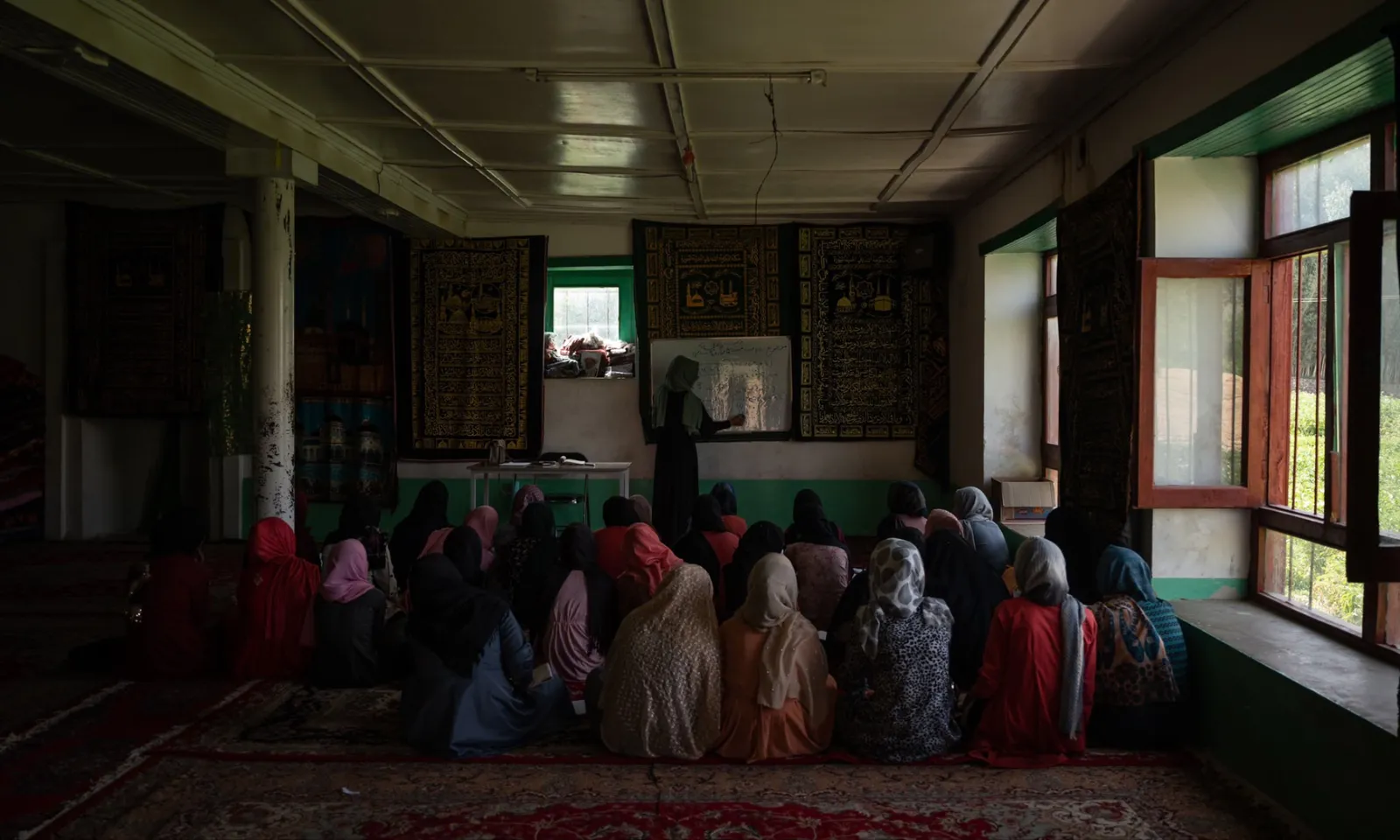
In Kabul, a girl’s backpack, carrying sharpened pencils or freshly washed gymwear, has become a symbol of her furtive education. By carrying it, she risks becoming a target. “The Taliban might follow the women with a backpack,” said Mursal Rahim, an Afghan woman who fled Afghanistan in 2021 and became a legal and policy advocate for girls’ education.
As Rahim recounted to The Politic , the choice for Afghan girls to attend underground school is “so dangerous” that “it can end up with them losing their life.”
And yet, she explained, “they are still fighting.”
For Rahim’s family, this fight is not new. Under the first formal Taliban regime from 1996-2001, her mother, Gulalai Rahim, quietly educated not just her household but also women and girls in their neighborhood out of a makeshift school in their family basement.
One older woman she’d taught to read—who later became the village’s first female nurse—paid tribute to that courage, telling Rahim’s mother, “It’s all because of you.”
Yet many Afghan women feel that such valiancy often goes unseen. “Too much coverage has two characters: the Taliban as the oppressor and Afghan women as the victims. The women themselves disappear somewhere in between,” said Pashtana Durrani , the founder of LEARN Afghan , an NGO that provides online education for grade 7-12 girls in Afghanistan.
Since the Taliban returned to power in 2021, some of these women have grown increasingly resentful of being pigeonholed as victims—defined by what they’ve lost instead of what they’ve built. Yet even when their work goes unseen or must stay underground, these women refuse to be reduced to victimhood: through education, through survivor-centered NGOs, and by reclaiming their own narratives in the media.
“We are not merely victims,” said an Afghan woman, who has chosen to stay anonymous due to fear for her own safety. Since the Taliban retook Kabul in 2021, she has been learning through an online underground school. “We have dreams, talents, and many abilities.”
The Taliban first seized Kabul in 1996, establishing the Islamic Emirate of Afghanistan. The regime invoked the Taliban’s interpretation of Islamic law, or Sharia, to justify sweeping restrictions on women’s education, employment, and freedom of movement. Many Muslim institutions, including the Organization of Islamic Cooperation, the world’s second-largest intergovernmental organization with 57 member states, reject these interpretations of Sharia law still used today, calling for restoring girls’ education in keeping with their rights in Islam.
The Taliban rule in Afghanistan formally lasted from 1996 until late 2001, when the U.S.-led invasion ended the militant group’s leadership. A U.S.-backed government held power for the next two decades. In 2004, the existing government moved from a temporary transitional administration to a constitutional republic, adopting a new constitution that guaranteed men and women equal rights before the law. In that period, the gap between how many girls were enrolled in school and how many actually attended became a point of contention. Some sources claimed that girls made up 39% of students enrolled by 2015, while others warn that these figures were inflated because many enrolled girls rarely or never attended.
In August 2021, the United States completed its military withdrawal from Afghanistan, concluding a process that spanned the Trump and Biden administrations. The Taliban retook Kabul thereafter, returning to power after what had been nearly 2 decades of frequent, localized insurgency efforts.
It has remained in effective control of Afghanistan since.
Under the Second Islamic Emirate, Afghanistan has seen new restrictions on daily life, with over 100 decrees stripping women of access to education beyond sixth grade, employment with NGOs and the UN, and public spaces such as parks and gyms.
As gender equality in Afghanistan continues to deteriorate, human rights advocates increasingly describe Afghanistan’s legal and social order as built around the systematic subjugation of women. “Five years into the Taliban's rule, they have institutionalized ‘gender apartheid’ in Afghanistan,” said Zahra Nader, the founder and Editor-in-Chief of the Zan Times , a women-led investigative news platform in Afghanistan. The International Labor Organization reported that Afghanistan had the second-lowest overall female labor force participation worldwide, at 5.1%, in 2026.
Fatima Faizi , an Afghan journalist previously with The New York Times , said, “Taliban ideology lives among even some women in Afghanistan. I remember talking to a friend, and he told me that his mom didn't want his sisters to go to school,” she said.
But if the Taliban’s ideology has found a place in the homes of Afghan families, so has the will to defy it.
Taliban restrictions have transformed Afghanistan’s education system beyond the exclusion of women and girls. “Most of their scientific subjects are replaced with religious studies. Biology and some other subjects are entirely eliminated,” Faizi said. “It's not just about the lack of access to education. It's about the education itself, and the quality of education.” Yet women continue to seek education as a means of resisting Taliban rule. Some attend underground schools operating under the guise of legal institutions, including within religious schools, while others turn to online learning to bypass restrictive laws.
Despite these hurdles, women in Afghanistan have a large historical precedence for fighting to receive any education possible.
In refugee camps, Afghan women who had paused their studies back home for their own safety did not wait for resettlement to resume them. They set up similar makeshift schools in refugee camps.
When reflecting on her time as a refugee in Pakistan, after fleeing Afghanistan when the Taliban was in control the first time, Wazhma Sadat stated, “I would weave carpets at night and go to a refugee school during the day.” Sadat was the first Afghan woman to graduate from both Yale College and Yale Law School, and was the subject matter expert on Afghanistan at the Special Inspector General for Afghanistan Reconstruction (SIGAR), where she wrote its quarterly reports to Congress.
Under the present regime, Inga Weller, a leader within Medica Mondiale , a women-led organization founded in 1993 to combat sexual violence, detailed how madrasas can provide opportunities for underground schools to operate. “Madrasas are religious schools, and they are not super controlled. That also allows for possibilities for underground schools to happen somehow semi-lega[lly].”
While secular education beyond sixth grade remains banned for women, madrasas' gender regulations vary by province. “Organizations are trying to use every opportunity they can to be very creative, and I think that's the power of Afghan women now…how they navigate the shrinking space that is available to them, and put themselves at risk too.” Private homes and community centers have also become locations for underground schools, Weller adds.
“Organizations are trying to use every opportunity they can to be very creative, and I think that's the power of Afghan women now…how they navigate the shrinking space that is available to them, and put themselves at risk too.”
Online schools are sometimes a viable option. Yet according to Rawadari , an Afghan human rights organization, access remains uneven, as women in remote and rural areas often struggle to get the internet access needed for online schools.
Shai Reshef, president of the University of the People, a prominent distance-education institution, said in 2025 that the university had 20,000 Afghan applicants but could admit only 4,300 Afghan women. Even when women want to study online, they may not be able to because of limited capacity.
Online schools also face the threat of intentional internet blackouts by the regime. On September 29, 2025, Afghanistan faced a nationwide internet blackout, which the Taliban blamed on old fiber optic cables. Weller, Nader, and Faizi all expressed worries that this nationwide blackout was a precursor to further nationwide internet restrictions.
Pashtana Durrani , the founder of LEARN Afghan , an NGO that offers online education, stated, “Before 2021, we were trying to solve an access problem. After 2021, we were trying to solve an access problem inside a system deliberately designed to prevent girls from learning.”
After Kabul fell, Durrani described how LEARN had to shut down to protect its employees and assess the organization's security. The model for the education they provided shifted in a way Durrani described as “decentralized.” Their current approach is tailored towards specific needs as it “builds around what is safest and most practical for a particular community.”
Now, Durrani says LEARN provides online education to 25 schools across 24 provinces, with 130 teachers and 5,000 students.
Durrani commented on LEARN's existence and what it means for Afghanistan's resistance. “If Afghan families did not want their daughters educated, organizations like LEARN would not exist. We exist precisely because families continue to take risks to educate their daughters.”
Violence and physical safety have become a primary concern for Afghan women, and another sphere where they have demonstrated their own autonomy and resistance.
For example, Fiazi commented on domestic violence victims being forced to return to husbands that had abused them She added,“After the fall of Kabul, violence against women is [essentially] legalized.”
In its 2022 report covering the first 10 months of the Taliban rule, the Human Rights Service of the United Nations Assistance Mission in Afghanistan (UNAMA) report ed that it had received 87 documented cases of violence against women since the 2021 Taliban takeover, none of which had been processed through the formal justice system. For women facing abuse at home, many formal avenues for pursuing justice have closed.
This figure almost certainly covers only a fraction of the violence women in Afghanistan are facing. UN Afghanistan warns that the dismantling of reporting mechanisms and fear of retaliation will make statistics like this difficult to aggregate.
Existing legislation and protections have also begun to falter. The Law on the Elimination of Violence Against Women (EVAW) was a landmark law passed in Afghanistan by presidential decree in 2009 that worked to address customs like child marriage and domestic abuse. Yet since then, these institutional mechanisms have effectively disappeared. Taliban has rolled back almost all of these regulations with different decrees, such as one decree that effectively legalized child marriage. Weller says these decrees nurture “a system of violence, of oppression, and of institutionalized violence.”
Nader reported in 2024 on one woman in Kabul who was arrested on the street by the Taliban for “bad hijab” practices and subsequently raped after being taken into custody. Similar stories likely remain untold.
Nader claimed the Taliban, at first, confirmed reports of these arrests and later, by going to community mosques, backtracked and stated these women had never been arrested in the first place. “They would subject these women to sexual exploitation inside the prisons. This was the story that would really stand against what the Taliban claimed to be.”
Nader further explained the backlash that rape victims face in Afghanistan. “It's a place where a woman who says ‘I have been raped’ is going to pay the price for being raped.” Honor killings, pre-planned murder of women and girls by family members, are sometimes carried out when there is a perceived social stain or infraction such as rape.
Despite these challenges, Weller spoke about Medica Mondi ale , a feminist NGO that focuses on rape cases in conflict and survivor-centered services. “Our main mission and goal is to end sexualized violence, especially in conflict.” She noted the efforts to work closely with Afghan women, especially through the branch Medica Afghanistan . “We built up an office in Afghanistan with the intention always in the background that we would hand over this work to Afghan women. The work was actually built up also with Afghan women.”
Weller described how the organization not only helps women through traumatic events but also in the aftermath, which can often include extreme isolation from their community. “It's crucial now to put the survivor in the center and see what the survivor needs not to heal, but to learn to live with these experiences.”
Weller emphasized that although their organization has struggled to operate discreetly in Afghanistan since 2021, media coverage should focus not only on the challenges women have faced since the Taliban has come back into power, but also on their courage in continuing to support one another. “Despite [the] risks, I think what Afghan women want us to know is that they are resisting. They are continuing. They are continuing to find ways to navigate that landscape, and that requires a lot of courage. And I think that courage needs to be made visible constantly.”
Many women interviewed by The Politic described how the media portrayal of the challenges Afghan women face under the Taliban overlooks many aspects of women's resistance.
Faizi detailed how her gender shaped the stories she could tell while reporting in Afghanistan from 2017-2021 for The New York Times . “It was easier to talk to women because there was probably some trust and closeness to a woman, and also sometimes I think women trusted me more.”
Nader reiterated this point when she spoke about the necessity for female journalists to cover sensitive topics like rape and abuse. “In this context—being able to get the story out—it was only possible through the work of a group of women journalists who were able to communicate and talk to these women and make them comfortable.”
While women have been explicitly banned from working in NGOs or the UN by the regime, there is currently no national ban on women working in private businesses in general, such as private media businesses. However, female reporters face more restrictions on dress, movement, and who they can speak to.
Nader described the added risk media offices take by continuing to employ female journalists, including the looming possibility of “morality inspections.” “Men and women are not supposed to be talking together, they are not supposed to be laughing, they are not supposed to be sharing an office,” she said. Taliban morality inspectors have been reported as coming to media offices to ensure gender segregation. Consequences for such infractions can range from warnings and detentions to physical violence.
After 2021, fewer women are in the media and in the workforce overall. Reporters Without Borders found that Afghanistan lost 219 of its 547 media outlets in the year after the Taliban retook control, and approximately 76% of female journalists have lost their jobs.
Restrictions on female voices in public also likely silence women as sources in general.
Nonetheless, Nader, the founder and Editor-in-Chief of the Zan Times , discussed the need she saw in Afghanistan for women to frame their own narratives. “We as Afghan women journalists were not telling our own stories. Our story was told either by Afghan male journalists or by international correspondents who are coming and visiting Afghanistan,” she said.
Faizi, however, is concerned with the lack of coverage altogether. “The only time that international media send their people to Afghanistan is the anniversary of the fall of Kabul. International media rarely captures the ways in which repression affects every sphere of life from economics to access to health care, Faizi emphasized.
Durrani shed light on how the media also often misses the ways that men and women work together in resistance.“There are fathers who bring their daughters to our schools. Brothers who help their sisters study. Men who quietly protect classrooms or help us navigate communities. Fathers who may never call themselves feminists or activists but will tell you, very simply, ‘My daughter needs to learn.’ That matters because sometimes the international narrative reduces Afghanistan to Afghan men versus Afghan women. It is much more complicated than that.”
Durrani also spoke about the need to change the questions we ask about Afghanistan. “I wish journalists would stop asking only, ‘How terrible has life become?’ and start asking, ‘What are Afghan women building despite it, and what would happen if we actually funded them?’”
With a de facto Taliban government reigning in Afghanistan, the question of how the international community should engage with it has become increasingly salient.
Weller raised concerns about the “normalization” of the Taliban regime, a term used to describe fears that negotiating with the Taliban government may accord it increased legitimacy. On July 3, 2025, Russia became the first state to recognize the Taliban as Afghanistan's legitimate government. In December 2023, China became the first country to accredit a Taliban diplomat as an ambassador.
The European Union (EU) also hosted the Taliban in Brussels to discuss deportation efforts of Afghan citizens residing illegally in the EU back to Afghanistan. While the EU claimed this was not an act legitimizing the Taliban, it has drawn criticism from Human Rights Watch and other organizations.
Rahim spoke about the stigma the Afghan government faces internationally when, in her view, many countries turn their backs on Afghan women. “As I said, it's not only the U.S. It's every country in the world that accepts principles of human rights. They have a responsibility to not forget millions of women,” she said. “Okay, they are Afghan, but they are human beings.”
Durrani described the stakes best. “The Taliban are betting on the world becoming tired before Afghan women do. I don't think we should prove them right.”
“The Taliban are betting on the world becoming tired before Afghan women do. I don't think we should prove them right.”