On August 7th, 2026, landmarks in Riyadh, Istanbul, and Islamabad lit up in red, white, and green—the combined colors of the Turkish, Pakistani, and Saudi Arabian flags.
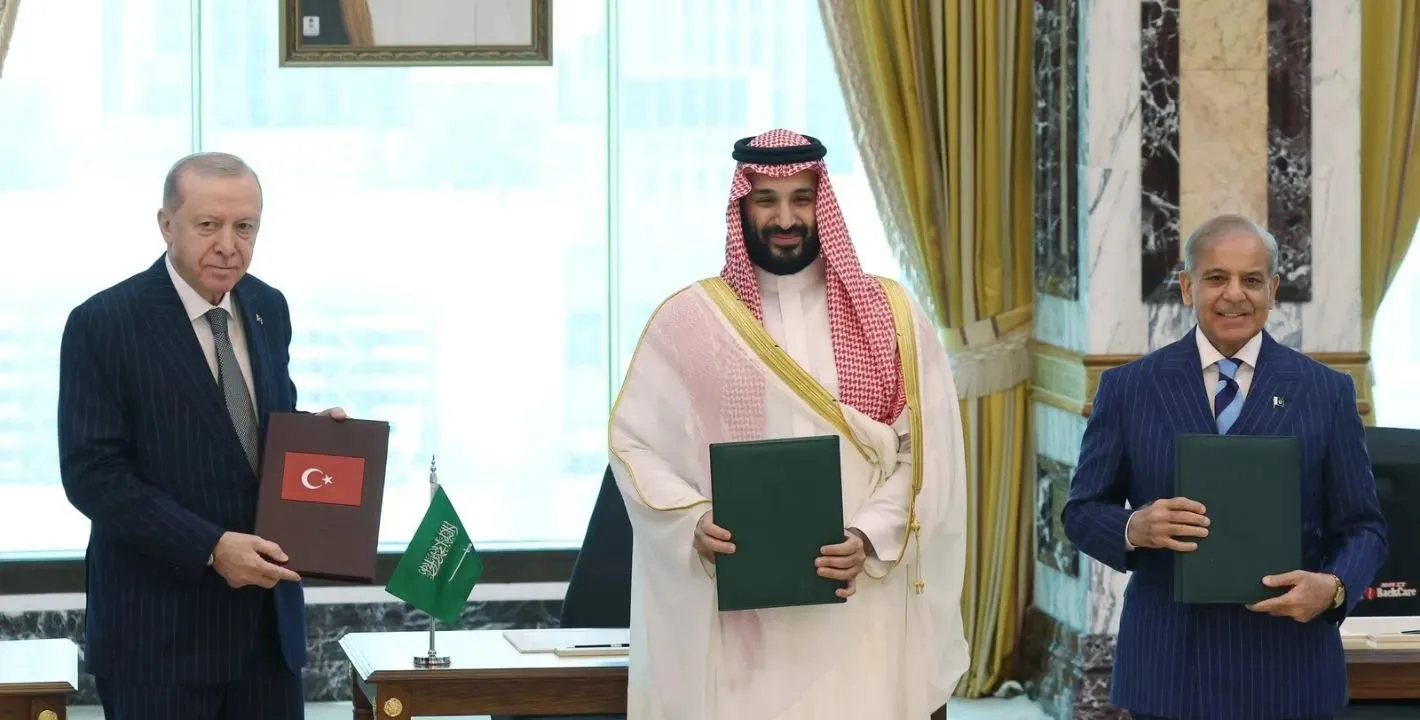
Earlier that day, beneath a portrait of Saudi King Salman in the holy city of Mecca, Turkish President Erdogan, Saudi Crown Prince Mohammed bin Salman, and Pakistani Prime Minister Shehbaz Sharif held up three folders for the cameras. The ink of their signatures bound them to the Mecca Joint Defense Agreement, a historic trilateral security pact.
On September 8th, a little over a month after the signing ceremony, the skies—now empty of fireworks—filled with Houthi ballistic missiles and suicide drones.
Saudi Arabia awoke to buildings in ruins—rubble from state-owned oil plants and critical civilian infrastructure littered the streets, and black smoke clouded the sun. 73 people were wounded in the aftermath of the Houthi-led attack. It was the heaviest barrage since the Houthis declared a naval blockade on the kingdom in July. Coming immediately after negotiations, the strikes sparked widespread unease and doubt about the newly signed agreement. With the agreement’s first test, the Mecca Pact has put its gradual obligations to the test in how quickly alliances can respond.
Although the parties have not released an official text, statements from officials on the Mecca Pact indicate the countries have agreed to a collective defense agreement modeled on NATO’s Article 5 , where an attack on one is an attack on all.
However, the pact is nowhere near a NATO-style military agreement. It reflects a consequential shift in the Middle Eastern order, with three regional powers aiming to increase their collective leverage; not necessarily to draw others into a military conflict but to add political weight. Still, the pact’s publicly reported terms do not clearly establish what specific assistance each country must provide. To Bilal Saab, Chatham House Associate Fellow in the Middle East and North Africa Program, that means the pact is “primarily based on deterrence. And if deterrence fails, then it's a giant question about the utility of the pact.”
primarily based on deterrence. And if deterrence fails, then it's a giant question about the utility of the pact
Ambassador Barbara Leaf, former U.S. Assistant Secretary of State for Near Eastern Affairs and former U.S. Ambassador to the United Arab Emirates, called the pact a “project under construction.”
“It’s a mistake to look at it as a simple military alliance that will put boots on the ground wherever any of these three feel vulnerable,” she said. “I think its weight will come from the political heft it can give in aligning its approaches.”
“The Mecca agreement didn't just come out of the blue,” Saab told The Politic .
It builds on the Strategic Mutual Defense Agreement: a bilateral security pact Saudi Arabia and Pakistan signed on September 17, 2025. The SMDA commits both states to the same mutual defense clause, formalizing nearly eight decades of security partnership. The Mecca Pact was the natural next step, extending the partnership to Türkiye, a regional defensive powerhouse.
Türkiye brings industry, Pakistan brings manpower, and Saudi Arabia brings money. The prospect of billions of dollars in Saudi investment is a key driver propelling this agreement.
Türkiye’s interest in Saudi financial backing, particularly as it continues to struggle with inflation and looks to fund defense research and development, puts money at the forefront for both nations. Türkiye remains a defensive leader in the region, setting the standard for developing missiles, naval systems, and armed drones; Türkiye’s Bayraktar TB2 drone garnered international recognition for its capabilities. The dynamics are evident: Turkish supply meets Saudi demand.
Pakistan displays similar motivations. Facing years of recurring financial distress and reliance on financing from the International Monetary Fund, Pakistan hopes to leverage its conventional military strength by using its large troop numbers and nuclear weapons as bargaining power in exchange for access to Saudi capital. In turn, Saudi funds could provide a critical lifeline to Pakistan’s fragile economy. This lifeline was confirmed in the days before the Mecca Pact signing, when Saudi Arabia deferred the central bank of Pakistan’s payment of more than $5 billion US dollars instead of rolling it over annually. Together with $3 billion in new deposits pledged in April, Riyadh now holds $8 billion in deposits at Pakistan’s central bank.
“The bottom line pulling them together is money,” Dr. Gause asserted. The economic imbalance among the three members, though, raises concerns that the pact will likely remain heavily dependent on Saudi Arabia rather than be distributed among all members.
Saudi Arabia’s deep pockets remain free-flowing as long as the oil under its control does the same. Oil accounts for about 60% of government revenue and approximately 65% of exports. It therefore sustains the kingdom’s defense spending, economic ambitions, and ability to cultivate strategic partnerships abroad, such as those through the Mecca Pact. A comprehensive security strategy that relies on fluctuating oil prices remaining high constrains Riyadh’s spending choices.
Yet high, stable oil prices have proven a fantasy over the last six months. Volatility and tensions have defined the region. Dr. Kristian Coates Ulrichsen, fellow for the Middle East at the Baker Institute, reported that “for the first time, there's a sense of so much uncertainty that we don't know what's going to happen next month, let alone next year.”
For a region whose economic fortunes remain closely tied to global oil markets, Iran’s attacks across the Gulf have threatened regional energy supply stability. Iran has proven to possess the willingness and capabilities to engage in a Gulf-wide conflict—the regime has managed to close the Strait of Hormuz and attack critical energy infrastructure in neighboring states for nearly eight months. As a result, the Kingdom of Saudi Arabia saw a 25% contraction in oil activity and a decrease in the country’s GDP.
Saudi Arabia now finds itself “in the middle of a conflict zone that they cannot really control,” Dr. Ulrichsen stated.
Further, according to Dr. Ulrichsen, Mohammed bin Salman called Trump twice on September 10th, and both times Trump told him it was not America’s fight. Pressure from all fronts and the absence of American defensive intervention for Saudi Arabia exacerbate Riyadh’s precarious position.
The Iran war turned the region's assumption that the U.S. is a reliable partner on its head.
“All the Gulf states were shocked at how all the investments they had pledged to the U.S. in 2025 didn't give them any sort of seat at the table when the Trump administration was deciding whether or not to go into Iran and how,” commented Dr. Ulrichsen. Anxiety dug in when member states realized defense spending and an established base with Washington will not prevent every attack. Not only that, it can’t even guarantee an ear to concerns. Negotiations that devolve into a ‘listen and be told’ model promise nothing more than vulnerability. Those doubts and fears lead to one echoing question: when America is no longer the world’s source of security, what is left to do?
The Mecca Pact emerged from this new calculus, pursuing strategic regional autonomy. As Dr. Ulrichsen put it, it's about ensuring “they do not have all their eggs in one basket.” Dependence creates vulnerability. Diversifying partnerships allows room for negotiation, reducing the leverage the US or another power can exert over foreign policy.
These countries are not trying to choose a new protector. This pact doesn’t shut out American arms sales and cooperation; it supplements Washington and opens up competitive markets.
While the pact brings optimism into how the region may be newly ordered, the region’s track record for these alliances has been poor. The Arab League’s 1950 Joint Defense Treaty , the Peninsula Shield Force , and the Islamic Military Counter Terrorism Coalition all failed to produce durable impact.
New partnerships won’t deliver security simply because they exist. Countries must know how to leverage these relationships more effectively. “Diversifying that model of inefficiency and ineffectiveness actually makes the problem worse,” Saab said. “Then you end up with multiple partnerships that are not working as opposed to just one.”
“So if that’ll be the same formula with the Mecca agreement, relying more on Türkiye, relying more on Pakistan and not building that connective tissue as well as actually building military capability, then you’re going to fall short just like you did with the U.S.,” Saab explained.
Despite the announcement of a new security pact, a stress test emerges as there is little to suggest that Turkish and Pakistani leaders are eager to join the ongoing dispute between Saudi Arabia and the Houthis.
The allies’ motivations are not frictionless.
Pakistan, though seeking access to Saudi capital and cementing itself as a larger influence in the region, remains a primary concern; its strategic calculus extends beyond just India and its own regional tensions. As an emerging mediator between Washington and Tehran in negotiations over the Iran War, Islamabad has an interest in preserving relationships with both sides. Pakistan therefore looks to delicately balance reassuring Riyadh of its security commitments without jeopardizing its diplomatic role.
In Türkiye's case, Erdoğan sees Mecca as an opportunity to expand its diplomatic reach while retaining its NATO membership, European ties, and managing internal political disputes. With this in mind, Türkiye expects to supply technical defensive support while limiting its commitments to avoid high-risk offensive combat.
These diverging priorities raise a fundamental problem for the pact’s durability by questioning which threats warrant a collective response, who is actually meant to respond, and the strength of that response.
“I don't think the three partners share a common strategic enemy that would be worth going to war for all three of them,” said Dr. Gause.
Sina Toosi, senior non-resident fellow at the Center for International Policy, illustrates this divide through the countries’ existing rivalries. In the past year, “The Pakistanis just fought a war against India. Saudi Arabia and Türkiye are not trying to get involved in that. Türkiye itself has disputes with Greece, has disputes with Israel, has disputes with Armenia, and was heavily involved in the Armenia-Azerbaijan war. I don't think Saudi Arabia or Pakistan want to get involved in any of that.”
As Saab put it, “If you don't agree on who your enemy is, then it becomes very difficult to imagine a scenario where you're going to fight together against that enemy.”
“If you don't agree on who your enemy is, then it becomes very difficult to imagine a scenario where you're going to fight together against that enemy.”
Currently, the enemies these countries align against appear to be related to the money both Pakistan and Türkiye rely on. But if Saudi Arabia expects to shoulder the brunt of the check, would Riyadh seek greater influence over deployment? Financial incentives go only so far when collective defense risks drawing Ankara and Islamabad into conflicts that contradict their strategic interests. The question then becomes not whether the countries can set aside every difference in the name of security, but whether they can agree in advance on which differences they are willing to set aside and what they’re actually prepared to risk for one another.
With that distinction, cooperation becomes costly. Iran illustrates that problem outright: Saudi Arabia sees Tehran as a major security threat, but Pakistan and Türkiye have their own reasons to preserve relationships with Iran. As Toosi explained about Pakistan and Türkiye, “They don't want to fight Saudi's wars, just like Saudi's not going to fight Pakistan's wars against India or the Taliban and Afghanistan ”
Even if the signatories were to agree on which enemy, translating that commitment into action is a different battle in itself. Dr. Qamar Cheema, Executive Director of Sanober Institute, Islamabad, cautions that “the pact doesn’t mean Türkiye or Pakistan immediately send troops. Pakistan has already stationed its thousands of soldiers in Saudi Arabia, and may be contributing intelligence.”
Türkiye’s participation faces a separate hurdle: more than two months after signing, the pact has yet to go before the Turkish parliament, which must approve any deployment of troops abroad under Article 92 of the constitution. Without this parliamentary approval, Turkish forces would face legal restrictions on troop deployment in support of the other Mecca Pact countries.
Even with ratification, Türkiye’s contributions would be shaped by constraints extending beyond the pact itself. Its military forces and defense industry remain heavily integrated with NATO, while important systems rely on U.S.-made technology. U.S. export controls can restrict the transfer of controlled defense technologies to third parties without authorization, potentially limiting the technologies Ankara can share with its new allies. A wrench in any plan to put troops on the ground, especially since Türkiye’s defense industry is a key draw for allies to participate in this pact.
However, even amid these doubts,t he countries agreed to establish a permanent secretariat in Saudi Arabia, currently headed by a Pakistani secretary general for three years, after which the position will rotate . It signals a shift from a symbolic document toward a standing structure that could make rapid mobilization easier.
In the weeks since, the Mecca Pact has had little time to breathe.
On October 5th, 2026, almost a month after the September 8th barrage, an emergency meeting in Riyadh between the three countries’ defense and foreign ministers announced their decision to invoke “ collective deterrence ” measures and rapidly deploy military capabilities to Saudi Arabia. Collective defense was no longer abstract. Since then, on October 8th, Pakistan’s military spokesperson confirmed that an undisclosed number of Pakistani forces were deployed to Saudi Arabia. However, these forces would not cross into Yemen to attack the Houthis, their purpose being only to defend Saudi territory and sovereignty. In the days since October 5th, Türkiye is providing technical support through intelligence sharing, drone operators, and logistical support for improving Saudi defensive planning—all the while its ground troop deployment remains unconfirmed.
The actions taken paint a picture of a middle ground between “being more symbolic but also practical,” according to Dr. Guase.
It’s unclear if the countries will get involved in attacking Yemen, as Toosi observed. If “by chance they get involved, I would imagine that's going to be much more symbolic just to show this pact is credible,” rather than changing the battlefield equation.
Five days later, the promise of collective deterrence collided with the reality of further attacks. On October 10th, Riyadh was quiet as King Khalid International Airport—one of the country’s principal gateways to the rest of the world—became a scene of devastation. The airport, usually alive with the bustling movement of travelers, was struck by a single Houthi missile. Chaos ensued. Plaster and tiles littered the floor as the roof collapsed and alarms and overhead speakers blared, warning travelers to evacuate. Billowing black smoke framed the aftermath as the death toll from the attack rose to 13, with more than 300 others injured.
The following day, October 11th, offered little respite. Another projectile struck Passenger Hall No. 4 of the same airport. Authorities rushed to deal with the fire ignited, reporting one killed and 11 others injured under a sky where air defenses intercepted additional incoming missiles. Riyadh was again confronting the human cost of attacks on its own soil.
A pact can be invoked in a meeting room, but its credibility cannot. At Riyadh's airport, that distance became painfully visible.
The pact reflects a region increasingly uncertain that Washington can be relied upon to guarantee its security. The Mecca Pact may have brought three countries together under the language of collective defense, but whether that solidarity can survive the moment it demands remains an open question.
In the meantime, the world will have to watch how many attacks Riyadh can absorb before that question is solved.
This was written with information up to October 18th.