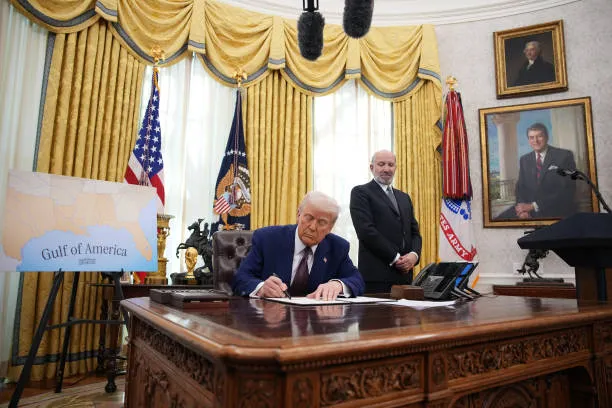
On January 20, 2025, on the first day of his second term, President Donald Trump signed Executive Order 14172, renaming the Gulf of Mexico to the Gulf of America.
This marked the start of the Trump administration’s initiative called Restoring Names that Honor American Greatness.
That same day, Trump signed another executive order to rename North America’s highest peak from Mount Denali to its previous name, Mount McKinley. Trump claims that this action was to honor former President William McKinley, which comes at the expense of Alaska’s indigenous heritage. In his words , this name change was intended to “restore the name of a great president, William McKinley, where it should be and where it belongs. President McKinley made our country very rich through tariffs and through talent.”
Trump’s efforts to redefine America’s geographic identity were far from over. On August 26, 2026, President Trump signed an executive order directing the U.S. Department of the Interior to rename Lake Ontario to Lake America. The order was titled Honor the American History of the Great Lakes and Renaming Lake Ontario to Lake America.
For some, the initial reaction was indifference. Dominic Erdozain, author of the critically acclaimed book To Love a Country: The Problem of Patriotism in America, laments that his initial thought was “just Trump being a bit petulant… you don’t take it seriously.” But as Trump’s renaming project progresses, that point of view has shifted. Erdozain felt this shift when he saw that “Google instantly changed [Lake Ontario] pretty much overnight.” He thought to himself, “Maybe that is power.”
This assertion supports a broader view of America’s soft power and the influence of naming. Names and labels created and mandated by the government often serve a larger, symbolic role; they represent that country’s citizens, values, and overall sense of patriotism.
Under the Trump administration, the emphasis on these symbolic names has become detached from modern American patriotism. Rather than viewing these actions as a reflection of patriotism as a whole, people have associated them with Trump himself. Commenting on Trump’s renaming policies, Zach Jewell, a writer for the conservative-leaning publication Daily Wire , said, “It’s Trump being Trump. He’s the ultimate troll.” This widely held perception contributed to Trump’s rise to power in 2016, from reality television star and businessman to politician; it also supported his reelection in 2024. “It’s something that only Trump can do and get away with, and have it work to his advantage,” Jewell added.
In fact, Trump has built his platform on these actions. Since his 2016 presidential campaign, Trump has made an effort to showcase his nicknames for his opponents: “Crooked Hillary,” “Lyin’ Ted,” and “Crazy Bernie,” to name a few. After ten years of exposure to this rhetoric, Americans may have become desensitized.
Steven Smith, a Professor of Political Philosophy at Yale University, emphasized that these actions align with Trump and his “Make America Great Again” narrative. “It's a kind of classic stab-in-the-back theory narrative,” he said. “America has been victimized by feckless elites. It's been victimized by internal enemies. Today, those are immigrants and journalists and whoever he chooses to victimize.”
For Smith, these renaming actions mirror historical attempts to reclaim American patriotism from an internal enemy.
He claimed, “McCarthyism played very much to this stab-in-the-back theory, and Trump is very much an heir to this way of thinking. That is his narrative.”
Trump’s infamous brazen rhetoric and messaging is something that can be seen as the legacy of McCarthyism : a political tactic built upon crafting an “us-versus-them” universe through direct accusations, intense language, and media manipulation. Smith argued this tactic is at the heart of Trump’s narrative.
Burcu Baykurt, an associate professor of Media Studies at the University of Massachusetts Amherst, emphasized that this narrative is not unique to the United States. “I don't think this is specific to Trump or something that he does better than others,” she said. According to Baykurt, if a leader wants to distract their constituents, “they can pick a really contentious topic or action, and that gets people really riled up. That's a very old PR tactic.” This tactic is the same one used to evoke reactions against internal threats to American greatness, bleeding into how patriotism is viewed in contemporary US politics.
Baykurt differs from Smith in that she believes the concern with these actions is less about the actions themselves and more about the strategy behind them. “A populist leader can also get people riled up about good causes if they understand how media operates. So, it's really more about the ends of what the administration here or elsewhere is trying to do,” she said. A polarized media environment plays into how Trump’s actions are perceived across the political spectrum, and that divide is clear in Erdozain and Jewell’s reactions. Jewell believes these actions are not cause for concern, while Erdozain sees them as potentially alarming.
Erdozain argued that this behavior predates Trump, but that “he’s showing the absurdity of it in a sense.”
He pointed to Abraham Lincoln. “You see this with someone like Abraham Lincoln in the Civil War; he develops a kind of godlike status.” Lincoln’s elevated status during the Civil War illustrates this tendency. Erdozain claimed that there was a prevailing framing of “His Excellency President Abraham Lincoln.” Erdozain reached a single conclusion: his presidency began to resemble “monarchy.” Critics of Lincoln said that he governed as a despot, and “you see that in every war.” Erdozain built upon this idea, contrasting Lincoln's actions with those of a more modern president: “You see it in World War I with Woodrow Wilson in particular, and you create what Arthur Schlesinger Jr. called the imperial presidency .”
David Barrett, a professor of Political Science at Villanova University, argued that such “imperial presidency” practices stem from a desire for a presidential legacy. “Most presidents want to be regarded as great,” Barrett said. “It's important to be regarded as great.”
Even so, Barrett distinguishes between Trump and other presidents.
Barrett elaborated, “I think there's sort of an outsized ambition for that on the part of this particular person, Donald Trump,” he said. “There's really no other president like this in history. There simply isn't. I mean, you can find plenty of outsized egos. There's a lot of egotism and some arrogance.” As for the scale of Trump’s renaming project, “It's quite unparalleled in presidential history.”
Whether or not Trump’s motives for his renaming project are tied to imperialism, the effect is a propagation of American soft power.
Jewell holds a different perspective on Trump’s renaming project and the imperialist connotations many experts find. “I think it's more ridiculous for people to be outraged about it. It doesn't change your life; it doesn't affect your life. Call it what you want to call it.”
For Jewell, focusing on the effect of Trump’s executive actions is trivial and overshadows more pressing voter issues like gas prices, immigration, and inflation.
As executive overreach becomes more common, the line between what is legal and what is not grows blurrier. “I don’t think the American public has a clear sense of legality,” said Barret. “With Trump, there’s an assumption that he can do almost anything he wants.” The effect is that the line between restraint and executive overreach becomes practically invisible. For some, this manifests as believing people care too much about executive actions that seemingly do not affect the average American’s daily life.
“I think even the media focusing on this [the renaming of Lake Ontario] for as long as they did is getting this wrong,” said Jewell. “It's not as big of a deal as some other things that we could be focused on.”
Barrett and Jewell's opposing viewpoints boil down to a debate about what the American public should prioritize at the ballot box: issues that affect daily life or preserving the integrity of executive power.
While this dichotomy has persisted throughout American history, Trump’s recent actions have made it more tangible. On one hand, many believe the U.S. has bigger issues than Trump trying to plaster his image and brand on everything he wants. On the other hand, many believe that if the U.S. allows Trump to continue down this path without pushback from the American public, it may damage the integrity of the US’ soft power. “But there was a bit of a patronizing and ever so slightly hostile attitude toward the US, and it's increased,” said Barrett. He asserted that this is another impact of Trump’s continued renaming actions; it divides the American electorate on what issues are actually relevant at the ballot box.
this is another impact of Trump’s continued renaming actions; it divides the American electorate on what issues are actually relevant at the ballot box
These actions also reveal a divide in the way Americans approach the idea of patriotism. One version of patriotism seems rooted in traits of a past America, prioritizing a previous status quo marked by economic prosperity, American exceptionalism, and harmonious values.
The Trump administration espouses this version, especially through the rhetoric of its platform and actions: Make America Great Again, Restoring Names that Honor American Greatness, Honor the American History of the Great Lakes, and Renaming Lake Ontario.
“We don’t like Mexico right now,” said Jewell. “We have all these states touching the Gulf. Go for it, call it the Gulf of America.” Jewell reflects a line of reasoning that explains why many on the right embrace these names without hesitation. Patriotism in Trump’s America, then, holds international power and dominance synonymous with American pride.
This association of patriotism with American dominance resonates with many, but it is only one version of what it means to be an American patriot.
Erdozain believes patriotism is not about the United States’ past achievements or characteristics, but about the individuals in our country. He explained, “I love the idea of pluralism as American identity. You rub shoulders with people from around the world, and the sting of competition and distrust just evaporates.” Rather than viewing patriotism as tied to the U.S. on an international scale, Erdozain sees it as derived from consensus among people within the country.
Smith argues modern patriotism needs reform. “I would find a way to embrace patriotism. Americans are patriotic people. They want to be. They want to believe something positive about their country. They want an aspirational ideal for their country. Don't give up on that. And particularly, don't let MAGA and others fill the void,” said Smith. “There are other visions of what we can be as a people. I would double down on that.”
I would find a way to embrace patriotism. Americans are patriotic people. They want to be. They want to believe something positive about their country.
Smith points to MAGA as an appeal to the idea of a distinct American heritage based in the past. “Make America Great Again” implies that there is a version of America to return to, serving as the basis of Trump’s patriotism. This ideology underpins his renaming initiative. But, as Smith stated, patriotism is a widely personal and diverse matter. Erdozain reflects on his own definition of patriotism, quoting Randolph Bourne in his 1916 Atlantic essay, Trans-national America: “We have to embrace the paradox that our American political tradition, our American heritage, lies in the future, not the past.”
We have to embrace the paradox that our American political tradition, our American heritage, lies in the future, not the past