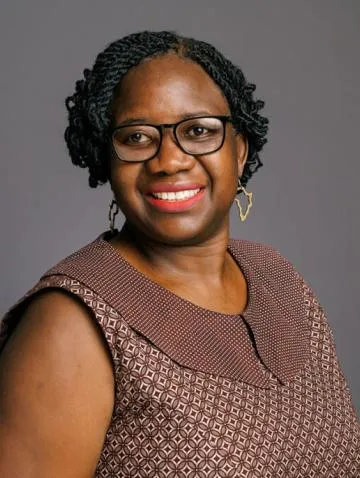
Janah Ncube is Deputy Chief Executive Officer at Crisis Action, a global organization that protects civilians in conflict. Previously, Ncube was the Pan-African Director at Oxfam. She worked across Mali, Niger, Burkina Faso, the Democratic Republic of the Congo, and Tanzania, among others. Her work has saved lives in over 15 crisis situations worldwide.
Originally from Zimbabwe, Ncube is an activist in the country’s struggle for continued democratic governance. As a true Pan-Africanist, Ncube also works towards a stronger African Union. In 2011, the Junior Chamber of Commerce named Ncube one of the Ten Outstanding Young Persons in Zimbabwe.
What do you do at Crisis Action? How does the organization operate?
I have been in Crisis Action for 10 years. Our mandate is the protection of civilians in conflict. We lead and coordinate our partners to reach an effective response to that conflict, so that civilians are best protected.
There is never one approach to any conflict, because every conflict is different. Right now we're wrestling with Sudan, and working on situations like the DRC and Syria. We've recently also been helping the Lebanese people mobilize resources for a reconstruction agenda after Israel bombed them in 2024.
Our work is to engage with decision-makers and those who hold power in each conflict situation, based on the outcome you want. Sometimes you are pushing for a ceasefire. Sometimes you are pushing for an aid corridor because there are no pathways for aid to reach ordinary people. Sometimes you're pushing for a peace agreement because the conflict has been going on and on, and there needs to be a resolution.
As Deputy Chief Operating Officer, I am currently supporting our team's work in the Sahel, specifically in Mali, Burkina Faso, and Niger, one of the deadliest regions in the world for terrorist attacks.
Could you tell us about specific situations you’ve worked on?
In South Sudan, we worked directly with civil society, catalyzing their efforts and helping them strategize a peace process.
When we started working with them in 2016, the peace process had reached a stalemate. No diplomat wanted to engage anymore, because they had gone through years and years of negotiations without reaching any resolution.
In the conflict, populations were fragmented, and political groups had separate constituencies that supported them. So we brought civil society from all the different groups and helped them facilitate an aspiration for a better country.
We supported them in delivering various campaigns—one of the most important being the "Spoilers of Peace." The president of South Sudan, Salva Kiir, was named the top spoiler of peace in South Sudan through an award show that our partners facilitated as part of a public campaign.
We then helped catalyze political leaders to come back to the negotiation table. There was also a private track of work by Sudanese civil society engaging diplomats at the African Union, the European Union, and the UN. It eventually culminated in a peace process and led to the 2018 peace agreement.
They are back at war again because elections have been continuously canceled. But for about seven years, South Sudan was at peace thanks to the work we contributed to, and I am proud of that.
Why was bringing civil society so important?
South Sudan is Africa's youngest country, and the United States was very helpful in that process. This came after years and years of contestation between the people of South Sudan, who have very different ethnic identities from those of the North.
What had not been taken into consideration at that time was how the people within South Sudan were also in contention with each other, and so when the new country got independence, people went, "Oh, now they can go off and be happily ever after." But it's like a marriage, and people were war-weary.
In the Sudanese context, the wealth of oil and resources is actually located in the south. So the oil would be pumped out, but the money would be invested in the north.
The war continued, and the world tried to come together to help them find peace, but they were really struggling to reach an agreement on how they could be self-governing while respecting their differences. In that context, we worked with partners to devise a strategy to inspire these people and remind them of a bigger aspiration beyond the things that caused their differences.
We worked with civil society organizations to help them forge a vision and recognize that they were better off working together for their country, and also reminding them that every extra day the country took to find peace meant even more suffering for people. Here, it was not just the war issues that happened, but the sexual violence and malnutrition that escalated the casualties.
There was also a time when all the leaders of the different factions had to go and visit the Pope. And the Pope washed their hands and kissed their feet, and they all were moved to tears.
This is some of the work we were coordinating behind the scenes.
So, that’s mostly what Crisis Action does — work behind the scenes?
Yes, exactly.
Conflicts are very sensitive. They are very political and fragile. It's important that the right faces, the right voices, the right actors are the ones presenting a matter.
So it is really about thinking strategically behind the scenes and facilitating the meetings—but you are not in the room.
If you Google "Crisis Action," you will not see us in newspapers because our job is to work behind the scenes. We're like a choreographer — if you go to a concert, you might think, "Oh, the guy playing the bass was brilliant," but nobody talks about the conductor.
What has Crisis Action done in Tanzania?
We've just had the Tanzanian elections last year [in October 2025], and you might have heard there's been a controversial issue around the number of human beings who were killed by the current President, Madam Samia. Civil society estimates that up to 2,000 people were killed.
Five years earlier, in 2020, there was a presidential election under President Magufuli. We had heard that Magufuli was planning the kind of violence that happened in 2025, but that kind of violence didn’t happen in 2020 because we ran a campaign. We had heard that they were planning to incite violence against the opponents of President Magufuli. We then devised a campaign in which we mobilized reporters at the UN headquarters and worked with the Secretary-General's team for him to go and address the media.
At that time, Tanzania was not on the radar. So, we positioned reporters to ask him questions about Tanzania. They started bombarding him with questions about Tanzania, and all of a sudden, Tanzania was in global media headlines about this looming violence. So the UN actually escalated its focus on Tanzania and on the elections, including the AU.
Civil society sent regional organizations to monitor the elections and created parallel processes and structures. And then specific messages were sent to the election officials in Tanzania's electoral body, making them aware that the UN was now watching them—so they exercised a lot of restraint, and there was no violence.
When the election happened last year, my heart was broken. Because it showed us that level of violence was likely to happen in 2020.
When the election happened last year, my heart was broken. Because it showed us that level of violence was likely to happen in 2020.
Because we didn't act in 2025, look at the number of people who got killed.
Because we didn't act in 2025, look at the number of people who got killed.
So why did Crisis Action not operate in Tanzania in 2025?
We act when partners or policymakers reach out to us. So in the case of 2020, that's what happened—partners came to us and said, "We need Crisis Action to help coordinate and figure out what we do to prevent this violence."
2025 was a very different year because you had all the multilateral organizations distracted by dysfunctions within them, and internally we faced a very difficult year.
The funding cuts also hit our organization, so we were going through a restructuring, and we had to let go of over 30% of our team.
I recall you also did work in the DRC. Is that right?
In 2016, President Kabila of the DRC was contemplating extending his time in power because his term had come to an end. We worked with women in the DRC, who decided to take different actions, including sit-ins. And then—I loved this tactic—they wrote him a petition and sent it to his house.
He ended up realizing that people were not supporting him and that maybe he should step aside.
And what has Crisis Action been doing in the Sahel?
It’s a very fractured, very restricted space. I think in the last couple of years, we've had five coups across the three countries [Mali, Niger, and Burkina Faso] in total. Right now, civil society has no voice in countries like Mali and Burkina Faso.
Back in 2011, when Colonel Gaddafi of Libya was killed, you ended up having an influx of arms coming down south, and conflict broke out. When the conflict in Mali broke out, the French came to rescue the situation.
I'm also raising this because no one talks about the gold, or the element that is used for nuclear power in Niger—uranium. Those critical mineral resources—that’s why you have a lot of these European countries sending in their militaries to stop the spread of terrorism. But it has continued spreading since that time, and it has made the people of the region really vulnerable.
So we built a coalition of local civil society leaders and actors called the People's Coalition for the Sahel, who ended up bringing forth a new strategic approach to the region, criticizing that a military approach hasn't worked, and that changed the discourse around the solutions being adopted for Mali, Niger, and Burkina Faso.
We facilitated their speaking at the UN. The first woman from Mali to address the UN General Assembly—we facilitated that. We facilitated their participation in EU meetings and presentations to the African Union.
You previously touched on the decline of the multilateral order. How do you think international organizations, with the UN at their head, should operate differently?
Honestly, multilateralism everywhere is failing, and the UN is perhaps the biggest, most specific example of that failure. And the failure is due to a lot of things, including that these were platforms for global governance but became tools for the powerful. The UN system is all about every country being equal as nations of the world—but we know that we are not equal. We know that those with power, money, and military hardware use that power. And those with power—our former colonizers—remain in the UN Security Council to this day. It ended up being manipulated by the powerful for their agenda and benefit, for example, through vetoes.
The other critique is that intergovernmental bodies are about preserving the power of the elites in those positions, so they are not about the interests of a nation. I'm Zimbabwean, for example. You would think when people from your country go and sit on these platforms, they're representing the interests of their countries, but really they are representing the interests of whoever is in power today, because they want to preserve how long they stay in power.
Thirdly, they just ended up being so expensive, such that most of the money they receive is spent servicing the machinery and not reaching the ground. When you look at money that's gone for humanitarian response or the World Health Organization, much of the budget is on salaries and the travel of UN officials, instead of actually buying the medicine and delivering it on the ground.
Reforms have to happen. I believe in multilateralism because of the nature of power and access to power in the world—smaller countries, smaller by size or smaller by resources, cannot compete equitably with those that have more. Multilateralism gives us a chance to come together and fight together and resist certain things together. I'm a believer in it, but it has to be redesigned.
Following on that—you’ve worked at Oxfam and also with organizations like the African Development Bank. I'm curious about your perspectives on institutions like the IMF and the World Bank. What do you think of their operating model?
A lot of these institutions were founded based on good intentions, and we shouldn't take that away. And a lot of these institutions have done good work.
In the last couple of years, we've been talking about the decolonial agenda within the development sector, both for international organizations like Oxfam and Crisis Action. The reason the criticism is fair is that they were founded by Western actors, designed from a Western point of view, and driven by Western people. As an African, I was forced to learn Pan-Africanism because I grew up in Africa and have had to live through the challenges that Africa and being African bring because of the history of colonialism. Being Black and African means I've had to learn the history of how my people were colonized, how my people were treated, and why we are so poor when we have so many natural resources.
So sadly, I think these organizations—even as they've meant well and have attended to issues well sometimes—have a Western lens, which has continued to influence how they engage. But I've seen that a lot more organizations are hiring people from the regions that they work in. So for me, for instance, at Oxfam, I was Oxfam Pan-Africa director. And my team—who were also mostly from Africa—obviously understood the challenges Africa was facing.
But there was still tension, because the budgets were held by people sitting in Western capitals, and I had to ask for money from them, and they had views and opinions about what we should be doing.
In your TEDx speech, you said poverty in Africa can be eradicated within this generation. Do you still think it’s possible? Do you see that happening primarily on the national level, or on a more Pan-African level?
It is possible. 60% of the most arable land in the world is in Africa. We can grow enough food, not only to feed ourselves, but also to feed the world. Just the Inga Dam in the DRC alone—if the water of that dam was harnessed, it can generate enough electricity for this continent and some of Europe. The resources are there. The median age in Africa is 19. So if you want to talk about labor for the world, we have all the resources.
The natural resources—all the diamonds—I can give you percentages and percentages. There is absolutely nothing that inhibits and stops us from being able to produce enough food to feed ourselves, and from producing enough wealth to take care of our people.
Two or three things, in my view, hinder us.
The African continent has a crisis of leadership. I struggle to call our leaders leaders, because leaders are about generating and inspiring their populations toward a vision and aspiration that benefits all of them. We have a crisis of leadership—people who only focus on themselves and their term of office and their acquisition of money, buying ten houses overseas, as if they can sleep in all of them at the same time.
The Epstein files prove that corruption is not an African disease. In Africa, we would always say, "Who is corrupting our African leaders?" It's Europeans who are actually corrupting our African leaders. In Germany, you could actually get a tax rebate on the amount of money you paid as a bribe to facilitate business on this continent.
So we have a crisis, but we also have a systemic problem. The institutions of the world were not designed to give Africans a fair chance. When you look right now at an African country trying to borrow money from global institutions for its development agenda—most of our countries have some of their biggest budget allocations going to service debt that was inherited from colonialism. We’re still paying interest on the money that our colonizers borrowed to kill our ancestors. And then the way credit rating companies rate our credit on this continent is as if we have no ability to pay—but the most indebted countries in the world are Western countries, not developing countries. The systems of the world have not been designed to allow those of us who were formerly colonized and denied power to compete—it's really still being preserved for the West and nobody else.
If these two issues were dealt with, we could solve all the poverty, and it wouldn't even take us 15 years. We’ve watched Rwanda—a country that was completely broken down — evolve in front of our eyes. In 30 years, it has become one of the most developed, most technology-forward countries in the world, where people live with absolute dignity, development, and self-actualization.
For my last question, I want to pivot to your home country, Zimbabwe. We've seen the governing ZANU-PF party unveil their 2030 agenda. How do you see the political trajectory of Zimbabwe?
My country is a sore spot, obviously, because it's my home. It's my passion. And I have been involved in its political trajectory since 1999.
Zimbabwe was one of the countries on the African continent you wanted to come to, because of its progressiveness and development. Countries in the region sent their kids to Zimbabwe for an education.
Watching us become one of the worst-performing countries now—one of the worst infrastructures on the continent, due to absolutely selfish, extremely poor leadership that is so focused on itself— is a tragedy.
The people who went to war of liberation were 14-year-olds, 15-year-olds. They laid their lives down so that we could be free from colonialism.
And to watch the ones who rule us now—who watched their friends die during the war so that we could get the dignity of self-rule and self-development and thrive—squander it.
I didn't participate in the war, but my father's siblings did, and died during this war, so that their children could live this independent life. So you would have thought that now, having won the prize of this freedom, they would be such good custodians—doing what the people of Rwanda did—leading themselves to a better future for themselves and their kids. Ours have been squandering it.
They have used their position to create a hegemonic system of power, and now it has become a kleptocratic system of power, because it's not only the hegemony of political power—there is now a layer of leadership, with the changes that have evolved, that is all about the money, the resources, and self-enrichment.
When you combine political power and the privatization of economic access and power, you close the political space to everyone and anyone. The military is used against the population. State institutions are used against the population. The people who benefit from this power are the very top political elites who make money through access to political power.
Last year, the government finally acknowledged that over 76% of our population is in the informal sector—if the state is saying 76%, it's in the 80s or 90s in reality. Our unemployment rates are so high.
There is an opposition, but really they work together with the state and the ruling party. So certainly, the trajectory—politically—this is what I see happening in the next 10 to 15 years. We need a new movement that represents the aspirations of the people. I'm a big believer in people power. Being a child of a former liberation country, I know that freedom is extremely expensive. It is paid for by people's lives, and that's what may have to happen in my country.
Do you see that happening anytime soon?
I think it has to happen. It's not going to come through elections. It's going to come through political contestation—when the people confront what is happening and are willing to pay whatever it takes.
Right now, anybody who can afford to jump on a plane and manage to get a visa out of this country is doing exactly that—but that's not what I want for my kids. I want my kids to love this country and want to be in this country, and want to work for it and contribute to it. So I can only be hopeful that this political change is going to happen.