When Russian troops were building up at Ukraine’s borders in the fall of 2021, few in Ukraine wanted to believe the invasion was going to happen. On December 3, nearly three months before the invasion began, American intelligence publicized Russia’s intentions : Russia was planning an offensive with up to 175,000 troops as early as 2022. Yet a full-scale war in the 21st century felt too “unthinkable” for many.
Now, the reports are back: the intelligence warnings, the Russian sabotage spreading across Europe, and the Baltic states gearing up for war. This has made me think back to the time when “unthinkable” was only months away.
I was among those who did not believe war would unfold. During school breaks in Kosmach, my small village in the West of Ukraine, I read the intelligence briefings and the leaked maps of troop movements; I watched the news and heard the repeated warnings: “ This is going to happe n ,” “ US expects Russia to invade Ukraine next week ,” “ Russian invasion may be imminent .” Yet, in those dark days, I told myself what everyone was forcing themselves to believe: Putin was bluffing, the costs were simply too high; no leader would gamble his country’s economy and army on such a war in the modern world.
I was among those who did not believe war would unfold.
Then came the morning of February 24, 2022. Air raid sirens went off across Ukraine amidst explosions, and by the time the sun came up, the Russian columns were breaking through the north, east, and south. The unthinkable happened, and the illusion of the impossibility of war was shattered with the first missiles crossing Ukraine’s airspace.
Then came the morning of February 24, 2022.
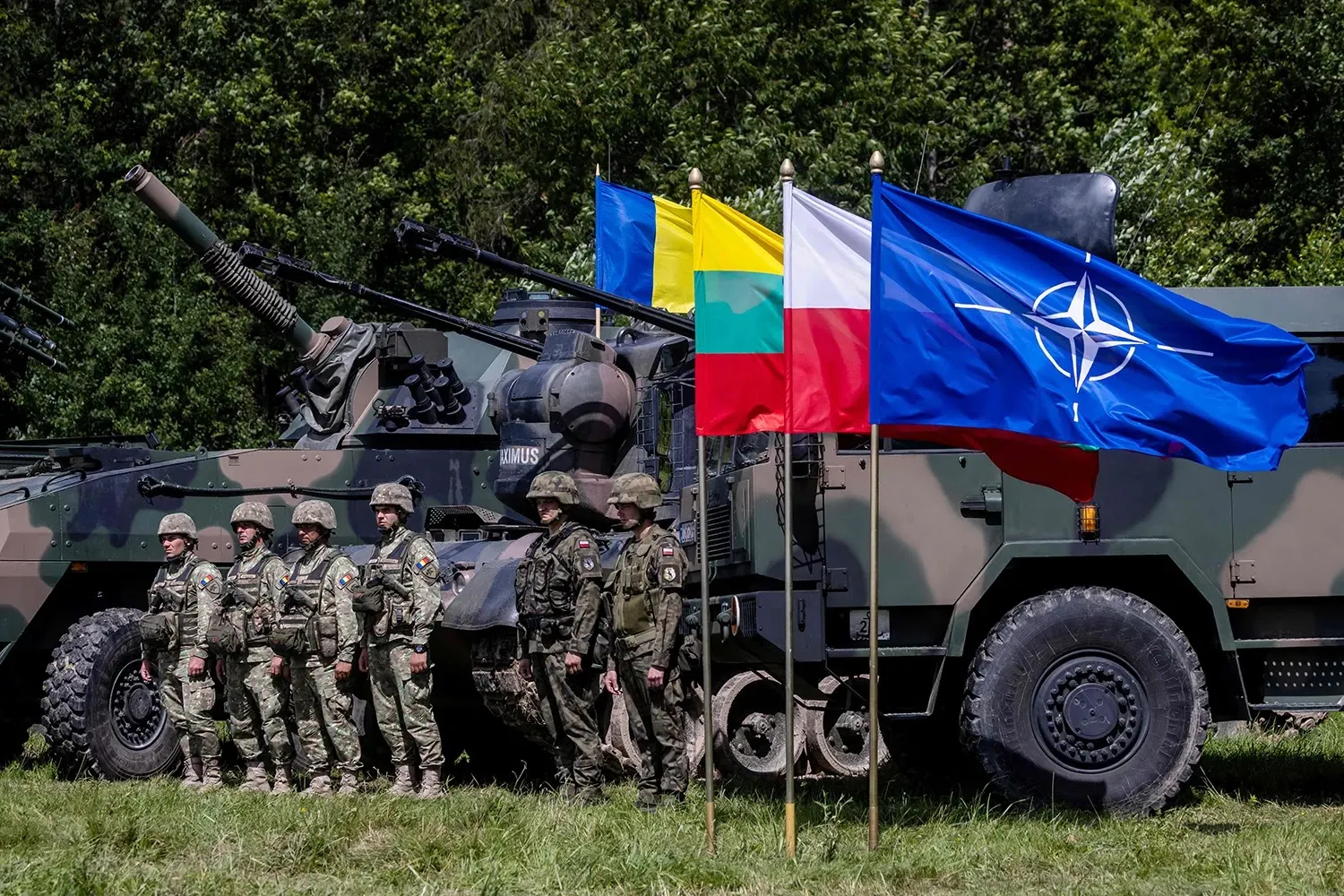
Today, the question is no longer whether Russia can pull off the ‘unthinkable.’ It is what happens if it does it again, this time against a NATO member.
Today, the question is no longer whether Russia can pull off the ‘unthinkable.’ It is what happens if it does it again, this time against a NATO member.
US intelligence had long assumed Putin would not provoke a NATO member while still fighting in Ukraine. However, this year American assessments have changed , now predicting possible Russian action against a NATO member between this autumn and 2029. In September, Denmark’s defense intelligence service warned of a “low but growing risk” of isolated missile or drone strikes on NATO infrastructure supporting Ukraine, possibly within months. “This could include destructive cyberattacks that cripple critical societal functions as well as sabotage attacks that carry a high risk of casualties,” the report claimed . Michal Koudelka, head of the Czech BIS Intelligence, told The Guardian that Russia could attempt a limited incursion into NATO territory, false-flag provocations, or a massive influence campaign, and that this could play out in a “matter of months, not years.”
The scenarios they describe share one feature: none look like February 2022. Each option is designed not to cross the line at which Article 5, which commits member states to collective defense, becomes obvious. I fear the aim would be to put the Alliance in a position where the issue is too big to ignore, yet too small to justify invoking Article 5 and risking direct confrontation with Russia.
Estonia’s foreign minister, Margus Tsahkna, declared on August 27 that his country’s threat assessment regarding Russia’s build-up has not changed, even as he stressed that Russia’s threat and possible provocations against NATO must be taken seriously. However, the absence of a military buildup as a main indicator of a threat does not mean the Kremlin is not planning to attack. A cyber operation or a small, limited land incursion would not require a visible movement of armed forces.
Imagine a city of half a million people in one of the Baltic states. Early in the morning, most are still asleep. The emergency alerts tested every month do not go off: no missiles or drones are in the sky. Instead, phones lose signal, banking apps freeze, and ports’ systems go dark. An hour later, unidentified soldiers are reported in a border town. The Kremlin denies any involvement and calls it an accident, one of many provocations and accusations, organized by the West to discredit Russia. Across NATO capitals, leaders now face an unsettling dispute. How they respond will test the alliance's cohesion and whether Russia has the means to divide it.
What worries me most is what happens next.
Western governments will search for answers, but this begs the question: Is it easy to prove that a cyber attack is done by a state, not a group of hackers, and that unidentified soldiers are Russians? When the details of the encroachments are hard to ascertain, NATO members may struggle to respond before it's too late.
Russia has done this before. In Crimea in 2014, soldiers without insignia, soon nicknamed “little green men ,” took over the peninsula before the world agreed on what it was seeing. Moscow denied any involvement: Putin called the troops “self-defense forces .” Yet, a month later, the Kremlin admitted that Russians were involved . In 2015, Putin proudly confessed that he personally ordered the operation. The world argued for weeks over who the soldiers were and how to respond, while the facts on the ground had already changed. The Kremlin took note.
In April of the same year, unidentified “self-defense forces” seized the Sloviansk local administration in the Donetsk region. Amidst Ukraine’s counteroffensives, Moscow went further. Unidentifiable Russian troops crossed the border in unmarked vehicles. The world witnessed each escalation unfold, while the Kremlin insisted it had no part in it.
The Minsk agreement halted the active war, though only on paper. Russia continued to maintain control over the territories. The Kremlin kept denying and claiming it was the self-determination of the people of Donbas. In 2022, Russia stopped denying and pretending. For NATO, will their involvement now be limited to condemning Russia's actions, or will the alliance retaliate?
That is where Article 5 becomes brittle. It commits each NATO member to take “Such action as it deems necessary, including the use of armed force, to restore and maintain the security of the North Atlantic area.” Each member has to decide what “necessary” means for them. Analysts at the Institute for the Study of War, a Washington-based think tank focused on military affairs, argue that a limited Russian strike or incursion would aim to exploit this fragility, leaving NATO’s decision-making body unable to agree on whether and how to respond. One country could send troops while another insists such a step is unnecessary, and as debate over involvement within the alliance persists, the situation on the ground might escalate.
Russia’s provocations are less concerned with ideology or acquiring territory, as seen in the invasion of Ukraine, and more with exposing NATO’s fundamental promise as flawed. If a seemingly unclear event successfully damages NATO's international credibility, Russia will understand that it can act more decisively.
Deterrence only works if the adversary believes in it. Russia does not need to defeat all of NATO’s armies. It needs to believe that no one will come to defend a particular place, or that whoever comes will arrive too late. Every sign of division and every statement of “deep concern,” repeatedly given by European and American leaders in place of action in light of Russia's advances, feeds that belief. If the Kremlin becomes convinced it is alone with its target, a full-scale attack starts to look like an opportunity.
In August 2026, CIA Director John Ratcliffe traveled to Moscow to warn Russia against attacking NATO allies, according to The Wall Street Journal . Personal visits by CIA Directors are unusual and have historically only been conducted for matters of the highest urgency. The last such trip to Moscow was in November 2021, when CIA Director William Burns made a final effort to deter Russia’s full-scale invasion of Ukraine. As the Institute for the Study of War argued , the manner of the trip suggests Washington sees the danger as closer than “the next few years.”
Russia has already begun provoking the West. Russian drones have repeatedly crossed into Romania, a NATO country’s airspace. In July 2026, Romanian F-16s shot down drones on three consecutive days. Weeks later, a Shahed-type drone flew too low for Romanian radar to detect before it crashed in Tulcea County.
In September 2025, at least 19 Russian drones violated Polish airspace in a single night, and some were shot down. In November 2025, an explosion tore up a railway line between Warsaw and Lublin that is used for deliveries to Ukraine. Polish Prime Minister Donald Tusk called it an “unprecedented act of sabotage .” Prosecutors are treating it as an act of terrorism carried out for foreign intelligence. On October 13, drones struck two ships off Bulgaria, sinking one, and eleven sailors were left missing. Bulgaria had asked NATO for aircraft, air defense systems, and counter-drone equipment.
Russia is not testing whether NATO can destroy a drone. It is testing whether the Alliance can agree quickly, with limited evidence, that it has been attacked.
NATO’s officials are, however, openly acknowledging the scale of the threat. Poland’s foreign minister, Radosław Sikorski, warned about the growing scale of Russian hybrid tactics against European states and said NATO must be prepared for casualties. “When do we recognize that the Russians have gone too far?” he said in the interview with The Financial Times . Alexus Grynkewich, the Supreme Allied Commander Europe, said that Europe must increase its support to Ukraine in response to Russia’s hybrid attacks. These statements suggest that NATO's military leadership takes the threat of attack seriously.
Deterrence, however, depends not only on military plans but also on the political decisions that enable them. And the most important of those decisions is the one that Grynkewich pointed out himself: to support Ukraine more.
However, Article 5 depends on each ally, and their views on Ukraine are shifting. In Germany, the far-right Alternative for Germany party, which wants to end all support for Ukraine, leads national polls at around 28 percent. In Italy, a new National Future party led by Roberto Vannacci pushes a similar agenda regarding Russia and Ukraine. The pressure, however, does not come only from the right. Slovak Prime Minister Robert Fico, whose Smer party is left-wing, said the war is neither Slovakia’s nor NATO’s. In Czechia, Andrej Babiš has halted aid to Ukraine and cut defense spending. Russia’s deniable attack would be built for this audience, because it gives every skeptical government a reason to say that the attack or even a war is too small, too unclear, “not our war.”
For NATO’s European members, however, that support is not solidarity or charity. It is a question of their own defense. Every Russian missile shot down in Ukraine is one that cannot be used on NATO. Every Russian soldier who is neutralized in Ukraine cannot be sent against Riga, Warsaw, or Tallinn. Ukrainian soldiers have learned lessons about drones and air defense that NATO armies are still trying to absorb. Ukraine has the strongest army on the continent, and its war machine has developed over years of existential threat. As long as Ukraine holds, most of Russia’s army remains tied down on its front line, far from the Baltics and the rest of Europe.
Article 5 is an American commitment, too. If Russia learns that a deniable attack can freeze the Alliance and that US troops across Europe might not come to defend one of NATO’s members, every US security guarantee, including with Taiwan or South Korea, from the Baltic to the Pacific, would be questioned.
Article 5 has only been invoked once in the Alliance’s history, after September 11, when allies went to Afghanistan to fight beside the United States. Roughly 1,150 non-American allied troops were killed, including 457 British soldiers . The allies unanimously agreed that America had been attacked, and some remained in Afghanistan alongside the US for about two decades. That is the standard that America set.
Defending any NATO member continues that standard. Deterring an attack, however, is far cheaper, and that is what supporting Ukraine does for America. Since 2025, European allies have bought American weapons for Ukraine through NATO’s PURL mechanism . American factories get paid, American soldiers stay home, and Russia’s army stays stuck on Ukraine’s frontlines.
As long as Ukraine is fighting, the threat to NATO will remain small: a limited attack or incursion, not a full invasion. But limited does not mean harmless. NATO still has time to prepare and make clear to Moscow that ambiguity over even a small attack will not buy it time. That means rehearsing the decision in advance: who decides, how fast, and on what evidence. It means putting air defenses and troops on the eastern flank before a crisis, not after.
NATO seems to be doing this already, but will politicians agree to the plans military leaders will present?
In 2021, the warnings were public and detailed, yet many still believed the unthinkable would not happen. NATO cannot afford to overlook the realities on the ground and must prepare for the “unthinkable.”