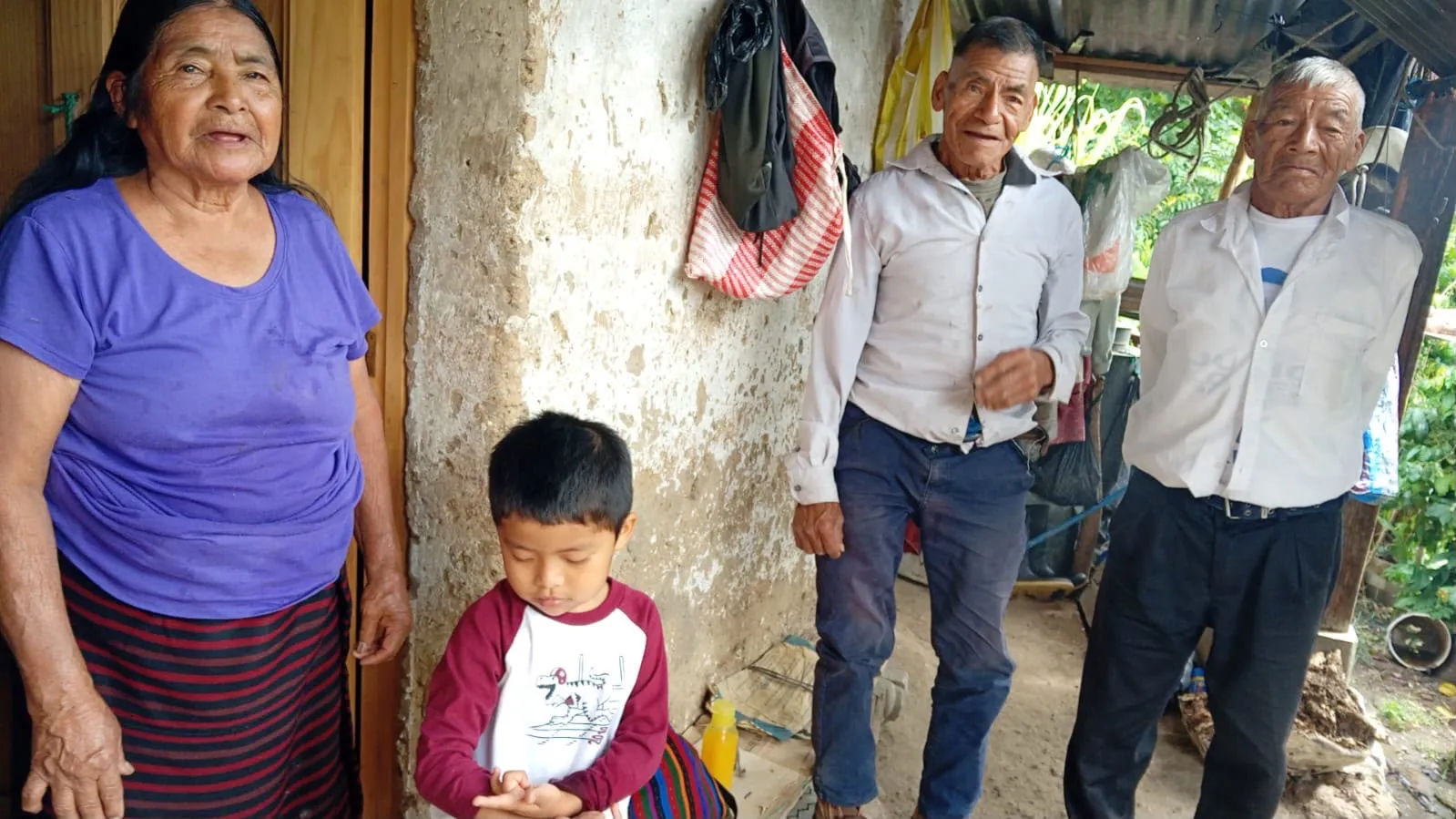
Wendy Domingo and her four younger siblings were born and raised in West Palm, Florida. Her father renovated their family home in his spare time, while her mom cooked for their neighbors. They were active members of their local church and had lived in South Florida since Domingo was six years old. “My parents were loved and respected by our community,” she said.
On August 9, 2026, one day after her 18th birthday, Domingo’s parents were detained by Immigration and Customs Enforcement (ICE). “We went out on a family outing; I was the one driving,” said Domingo. “I didn’t know we were being followed until I made one last turn, and at that last turn, there was Border Control.”
“We went out on a family outing; I was the one driving,” said Domingo. “I didn’t know we were being followed until I made one last turn, and at that last turn, there was Border Control.”
They were on their way back from church. Domingo, who describes herself as a safe driver, was behind the wheel of a car carrying her parents and siblings. At first, she didn't realize what was happening. When agents turned on their headlights and pulled her over, she asked whether she had done something wrong. “They said no, I didn’t do anything wrong,” she recalled. “It’s just the fact that the car was registered under my dad, and he’s an immigrant.”
The agents asked for any identification proving her parents were United States citizens. They did not have any. The agents told them they would have to be detained. Her parents did not resist. “They know how the situation is,” she said. “They didn’t try to fight, especially since all the kids were in the car.” Her father began a Facebook Live. A passerby also started recording. Domingo and her siblings hugged her parents and said goodbye. “That was the last time we’ve seen them physically.”
As ICE detentions expand , stories like Domingo’s are pushing America to answer a question it has long avoided: who is protected here, and who counts as an American?
Domingo has no doubts about why agents picked her car out of all the others. “I’m pretty sure we were racially profiled,” she said. Angel Escamilla Garcia, an assistant professor of sociology at Yale University, explained that street enforcement is designed to conduct arbitrary arrests because immigration status cannot be physically seen. “I think our current administration is making this a race issue,” he said. “The label of the undocumented migrant is not clear in any visible way unless you think about it as a race thing.”
When apprehending criminals depends largely on appearance, legal citizens also get caught in the crossfire. Patrick Jaicomo, an attorney at the Institute for Justice, a non-profit public interest law firm, represents Leo Garcia, a Latino construction worker in Alabama. “Leo’s an American citizen, and he’s been arrested three different times by immigration officers who eventually let him go after an hour or two and declined to look at his Real ID or passport,” said Jaicomo. Cases like Leo’s are multiplying as the number of detained citizens and legal residents continue to rise . “We can’t let the government cast any nets that are wide enough to do unconstitutional things.”
If proof of legal status does not stop the arrest, then the first test of who counts as an American isn't a legal one. It simply depends on whether you look the part.
Around 7:30 that evening, Domingo’s parents called from a Riviera Beach detention facility and told her to come collect their belongings, including their wedding rings. Domingo and her three closest friends drove over. “We didn’t even enter the place, and they still asked for our IDs,” she said. She still has her parents’ rings two months later.
Victoria Slatton, an immigration attorney who began her career as an Asylum Officer at the Department of Homeland Security, said Domingo and her parents’ disorientation is standard. “The first 48 hours are really rough, because the processing centers are not made to hold people for that long,” she said. “It’s when we prepare families that folks are going to go dark for a while.” Domingo’s parents were moved to Miramar, Florida, then they were separated. Her father ended up in Mississippi, her mother in Louisiana.
As part of the administration’s immigration crackdown campaign, upwards of $70 billion has been allocated to the immigration enforcement budget. Despite this surge in funding Slatton says, “they never seem to have enough to provide adequate care and facilities that meet basic human needs.” For at least one of these facilities, she thinks this shortfall is deliberate. “My client was in Alligator Alcatraz. I think the bad conditions are the point of it.”
Alligator Alcatraz, a former temporary detention center in the Florida Everglades, came under fire for its inhumane conditions, environmental impact, and international human rights implications. “It was designed to be that way, to instill fear for folks on the outside,” said Slatton. “And then also to punish and humiliate folks and get them to sign whatever they can to get out. I don’t think they were made by accident. They were made intentionally to be cruel,” he added.
Domingo’s family had lived in fear for years. Her mother stopped driving three years ago. “She just wouldn’t drive due to the fear of being pulled over,” said Domingo. Her parents avoided traveling together so they would not both be taken at once. In the end, it did not matter.
Julie Ear, a Los Angeles-based content creator and activist, saw that same fear at play with her own parents. Her mother, a seamstress, and her stepfather, a warehouse worker, had lived in Los Angeles for over 30 years. As the raids spread, they stopped going out. “They were like prisoners in their own home,” Ear said.
Ear’s mother worked extra jobs to save money and returned to Mexico in late 2025. Her stepfather followed suit after ICE showed up at his warehouse and he hid in the back. Nobody detained them. They left anyway. This is the system’s goal. A system built to spread fear does not need to detain everyone; it merely needs everyone else to see what happens to the ones it does.
A system built to spread fear does not need to detain everyone; it merely needs everyone else to see what happens to the ones it does.
Domingo’s parents, by almost any measure, participated in American civic society “the right way.” Her father worked side jobs while saving to start his own company and coordinating a group at their church. Her mother cooked on Saturdays and took care of Domingo and her younger siblings.
Domingo’s father came from Guatemala in 2004 and helped her mother come three years later. They settled down in Florida and lived there until their detainment. When Domingo posted about their detention, commenters said they should have obtained visas. “You don’t know how hard and how long the process is to get a visa. My parents spent thousands of dollars towards it, and nothing,” Domingo insisted. Money, not criminal misconduct, blocked the path to legal status.
Ear’s mother crossed the border from Mexico at fifteen, with her mom and sister. “It was three of them crossing the border through what they call coyotes,” said Ear. “She crossed the river, went through Texas, and through Texas she came to L.A.” Coyotes are human smugglers paid to guide immigrants across the U.S.-Mexico border. For a child like Ear’s mother some 30 years ago, a coyote may have been the only means to pursue the American dream. Her undocumented status was not for lack of trying. “My mom eventually got a work permit, but it expired, and she couldn’t reactivate it for financial reasons,” said Ear.
Professor Escamilla Garcia said restrictive immigration policy tends to result in increases in undocumented migration. People do not stop coming simply because lawful routes become harder. “When enforcement increases, the group that benefits the most is the migration industry,” referring to smugglers and traffickers like the coyotes that snuck Ear’s mother across the U.S.-Mexico border.
Even for those trying to migrate legally, Slatton believes the U.S. government's treatment of them will change. “There was this idea that if somebody went to their ICE check-ins, if somebody applied for asylum, if someone was in the process of getting a green card through family petition, if they had done all these things correctly, then they were provided some level of privacy, comfort, and discretion,” said Slatton.
Following the law and migrating the right way involves constantly updating information. Such bureaucratic procedures render those going through the immigration process easy targets. “It’s not hard to find a DACA recipient or Asylum Seeker because they’re constantly updating their information in order to follow the law,” said Slatton.
The result is a trap with no exit. The legal path can cost thousands and lead nowhere. The unlawful path runs through exploitative smugglers who only grow richer as immigration policy tightens. Those who stay on the legal path become the easiest to find. Slatton believes breaking this pact will not stop there. “If you can do it to one population, you can do it to the entire population, and it will fall like dominoes,” she warned.
ICE expansion is the latest stage in a shifting of the American security apparatus.
The shift first began in the wake of 9/11, when Congress passed the USA Patriot Act , widening government surveillance powers and establishing the Department of Homeland Security, which now includes ICE.
“If you look at the United States since 9/11, the domestic apparatus is geared towards the idea of security,” said Lee Morgenbesser, an associate professor of Comparative Politics at Griffith University. Morgenbesser sees what happened to Domingo’s parents as indicative of the U.S. becoming a security state, which he defines by three characteristics. The first is a government that points its power inward, to “the idea of internal security as opposed to external warfighting,” he said. Under the second Trump administration, he argued, the immigrant has been cast as that threat. A Border Patrol stop of a Florida family on their way home from church is a small-scale version of that shift.
The second is the politicization of security. According to Morgenbesser, ICE frames people, like Domingo’s parents, as threats to national security even if they have no criminal record, even if “there is no evidence that they are intending on being a threat.”
The third is consensus. Even as events become grotesque, “there is a degree of acceptance,” built on the idea that “no matter how morally objectionable some of the actions are, it’s all sort of necessary for the sake of security,” said Morgenbesser. If people accept that logic, he said, little organized opposition remains to push back.
Those markers describe a structure. What makes ICE unique within that structure is how it operates. ICE has been “repurposed, not even subtly repurposed, to carry on the vision of the Republican Party, of Stephen Miller, of Project 2025,” said Morgenbesser. ICE Agents have shot and killed American citizens like Renée Good and Alex Pretti , while the federal government has done little to hold them accountable , according to the American Immigration Council. Morgenbesser believes the reason for this brazenness is America’s democratic constraints.
“Given that America’s a democracy, if you want to do what ICE is doing, you’re going to have to move quickly,” he said. The four-year time scale of American democracy presents a time constraint that, for Morgenbesser, is the driving force behind the Trump administration’s rapid expansion of immigration enforcement. Morgenbesser doubts the administration can remove people at the scale it wants. The substitute goal is “creating a climate of fear and intimidation by arresting people on the street for just about any reason.” Fear is the product, and it does not require everyone to be caught.
Accountability, or lack thereof, is the foundation of this climate of fear. “The decision has been made by the administration to protect or provide an umbrella for ICE agents,” said Morgenbesser. “Then you add on top woefully poor training, lax recruitment standards…that’s when you get ICE as it is today.” In February 2026, Ryan Schwank , a former ICE attorney, testified to Congress about ICE’s training standards, including the use of mace during training and agents being told that they could enter homes without warrants, which violates the Constitution’s 4th Amendment
Agents receive encouragement for unconstitutional practices and face no consequences for these violations. “If you start out targeting illegals, it’s very easy for them to move on to other groups,” said Morgenbesser. “If you think ICE will ever stop at some artificial line and not go a step further, I think that’s quite foolish.”
“If you think ICE will ever stop at some artificial line and not go a step further, I think that’s quite foolish.”
A security apparatus geared towards domestic threats needs a definition of who that threat is, and that definition requires no change in law. It is set by the administration and ICE itself, and is flexible and at the mercy of whoever is in power. It does not have to depend on someone’s criminal background. Undocumented migration is not a criminal offense , yet under the Trump administration, it has been treated as such . Domingo’s parents were churchgoers integrated within their community. Ear’s parents worked and paid taxes in Los Angeles for 30 years. Both families tried to obtain legal status but were blocked by cost. In the end, none of this mattered.
“We’re a lot closer than people realize to waking up,” Slatton stated when discussing the public’s reaction to ICE’s unconstitutional actions. Morgenbesser is not as optimistic. “There’s a belief that it can’t happen here. Authoritarianism, that is,” he said. “Given what Trump has done, at what point is America going to stop him? The fact that it hasn’t happened yet is probably the most terrifying.” Even if accountability does come, a reckoning years from now does not reunite families. In the meantime, an immigrant’s sense of belonging and identity will continue to be threatened by an agent at a car window, and their protection will hinge on what officials in office are willing to allow.
And the cost of waiting falls on people like Domingo. She will start college in January, but for now, she heads her household. Her days are filled with bills, looking after her three siblings still in Florida, and phone calls with her parents and youngest brother in Guatemala. For her, the most troubling part of the crackdown is how people talk about immigrants. “They forget that we’re just human beings going to work,” she said. “They have family at home expecting them to come home.” What she fails to understand is how the people carrying out the arrests, and the country watching, can ever clear their conscience. “How can you look at your kids,” she asks, “knowing our kids are crying?”