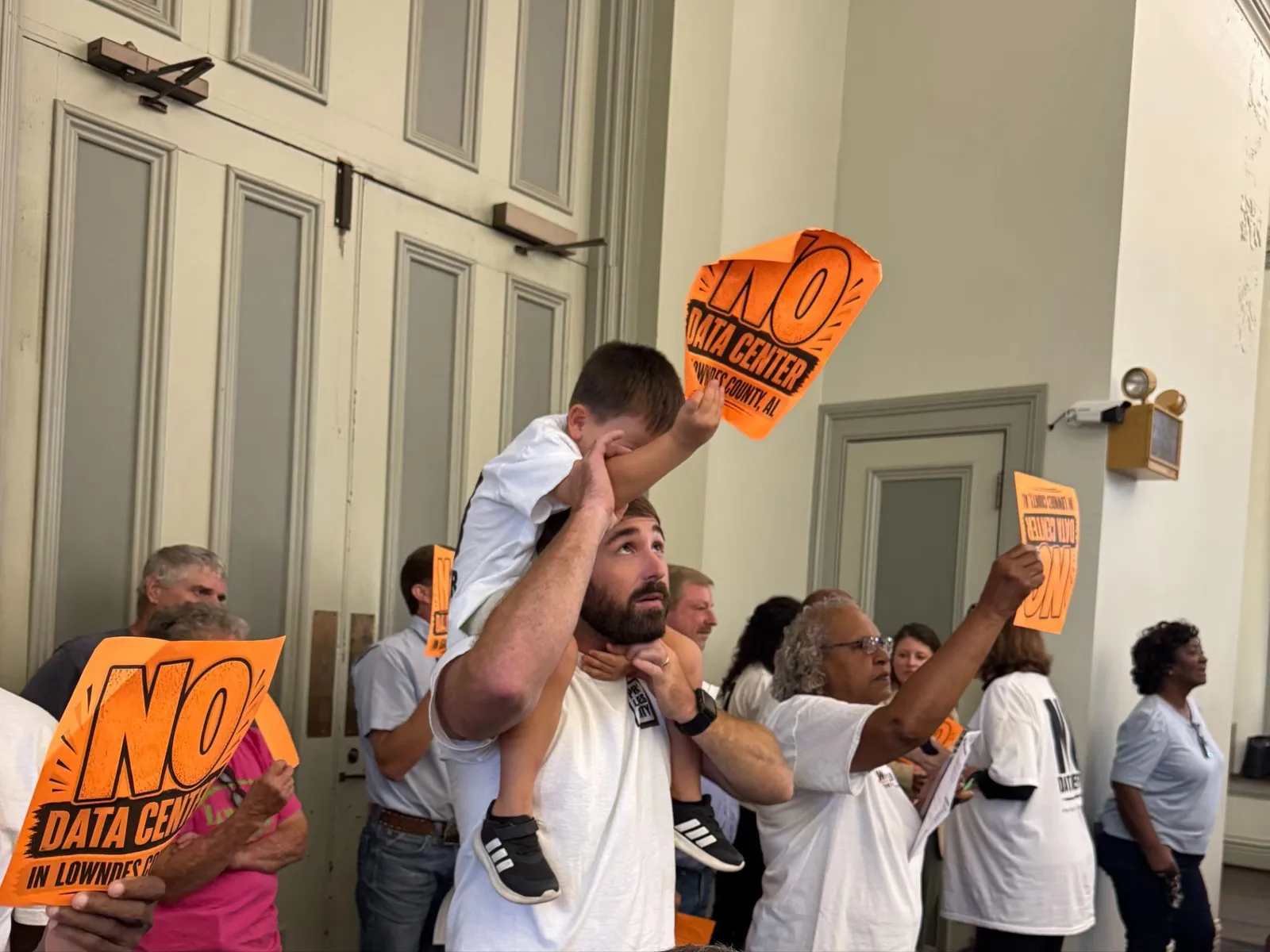
Little had ever given Hayden Freeman—a 29-year-old mechanic and a second-generation Lowndes County, Alabama local—pause as he read his hometown paper, The Lowndes Signal . That was until April 2026, when its headlines announced plans for a new hyperscale data center, slated for construction just miles from his childhood home in Lowndes County.
Freeman, a father of three, planned to build his family a house near the data center’s proposed site. The area was among the few newly developed pockets of Lowndes, one of Alabama’s poorest counties and home to approximately 10,000 residents.
“I was trying to think of what I could do to help in the fight, because I was not really into our local politics,” Freeman said.
The Signal ’s April headlines drew him into a political sphere he had previously avoided.
Thereafter, Freeman created the “Stop the Lowndes County, AL Data Center” Facebook group, an advocacy platform that coordinates efforts to halt the data center’s development. He and his neighbors raised more than $2,000 and made “SAVE OUR LAND” signs to protest the data center at a county commission meeting.
His efforts are part of a larger national backlash against data centers. According to a March Gallup survey, 7 in 10 Americans oppose building artificial intelligence (AI) data centers in their area. On July 18, opponents of data centers staged 142 protests across 42 states. According to Data Center Watch , a research firm that tracks data center opposition across the U.S., resistance from local residents disrupted $130 billion in data center projects in the first quarter of 2026, and the number of active data center opposition groups more than doubled since the fourth quarter of 2025.
For decades, many data centers existed outside the national spotlight—the quiet backbone of the data storage and cloud computing powering the modern internet. But attitudes toward data centers have since shifted. With the rise of AI, companies have needed to build infrastructure capable of meeting AI’s energy demands. In the Gallup survey , opponents of data centers cited environmental concerns, quality-of-life issues, and cost increases as their main worries, while two-thirds of proponents cited local economic benefits as a reason they favored the developments.
High-profile politicians have leaped into the fray, both in opposition and in support of data centers. On August 31, President Donald Trump said that American communities should “let Data Reign” to avoid being “backward and poor” in a Truth Social post . On September 14, New York Governor Kathy Hochul signed the country's first statewide hyperscale data center moratorium into law.
Even the proposed Lowndes County data center development, dubbed Project Red Clay, has drawn state and national attention. In July, Alabama Congresswoman Terri Sewell wrote an op-ed opposing Project Red Clay. In August, Democratic gubernatorial candidate Doug Jones spoke to Lowndes County residents about data center transparency. Democratic Lieutenant Governor candidate and Alabama State Representative Phillip Ensler attended several Lowndes County commission meetings where the data center was discussed.
Though data center debates have played out against the backdrop of Alabama’s statewide campaigns, data centers have divided not just high-profile politicians but local communities across Alabama. As a result, one of Alabama’s most polarizing issues is also one of its most personal—an issue that has broken trust in city government, unseated veteran politicians, and both united and divided residents.
Dissidents of data centers acknowledge the importance of economic development, but say that the lack of transparency surrounding data centers and the push for large tax breaks are unwelcome trade-offs for any economic benefit.
“We're not against all development in Lowndes County. We're against irresponsible development, and that's what we believe this project is,” Freeman said.
We're not against all development in Lowndes County. We're against irresponsible development, and that's what we believe this project is
Proponents of data centers include not only the data center companies themselves but also longtime local officials who believe data centers will bring a much-needed influx of jobs, funding, and businesses. Project Red Clay said it would create about 225 permanent jobs and 1,000 construction jobs. William Davis, a Lowndes County resident, wrote in an op-ed that the billion-dollar construction provides more tax revenue to areas that desperately need it, like rural areas with less economic development.
On its website , Project Red Clay states that it will provide $124 million in average yearly tax revenue for the county. That would more than double the county’s general fund for the 2026-2027 fiscal year. The developer gave county residents an ultimatum between accepting a surge of tax revenue and ignoring transparency concerns, or losing out on an unprecedented funding opportunity.
Lowndes County needs development. According to the U.S. Census, the county’s median household income is $37,052 , less than half of the national household median income of $81,604 .
“It would make a big difference,” Freeman said when asked about the tax revenue.
But Lowndes County residents are alarmed by the lack of insight into how Project Red Clay will affect water usage and electric power.
On its website, Cloverleaf Infrastructure states that the data center has requested up to 100,000 gallons of water per day. Such large water withdrawals can strain the water system overall, according to the N.C. State College of Natural Resources.
John Urquhart, a 59-year-old Lowndes County landowner, raised concerns that chemicals from the data center could leach into the water system.
“It could poison our well waters. And with the farms around here, you've got farmers that have got five, six, seven wells on their property, and chicken farmers that depend on well water,” he said. “It's just a frightening thing.”
Urquhart and his wife bought 230 acres of property in Lowndes County six years ago. Urquhart hoped to retire there, live with his adult children on the land, and watch his grandchildren grow up. But in April, he learned the data center developer had bought options for a 700-acre property 266 yards—less than the length of three football fields—from his property line.
“We sit on our front porch and can see one of the most beautiful sunsets you ever seen, and this is gonna be directly in that direction, you know?” he said.
He feared light pollution would ruin the view. The data center might look like “a Walmart parking lot glowing out there at night,” he said.
According to the Environmental and Energy Study Institute, data centers emit noise from cooling systems, fans, and diesel generators. Project Red Clay agreed to cap noise levels at 55 decibels, about the same sound level as a household refrigerator, according to Yale Environmental Health and Safety.
Urquhart took issue with the potential 24/7 humming.
“Their documentation says 55 decibels is what the max it's gonna be, but I don't want 55 decibels of sound anywhere, you know?” he said.
Whether the Lowndes County data center would receive over $1.1 billion in county tax abatements was decided in an unceremonious 10-minute meeting on a Tuesday morning.
Before that meeting, Lowndes County residents had sought answers from their county commissioners for months. The Lowndes County Economic Development Commission worked with Cloverleaf Infrastructure to bring the data center proposal to the county commission. Freeman described the commission as “pay to play,” with local businesspeople joining by paying several thousand dollars. Since the commission is a 501(c)(6) charitable organization, it is not subject to the open records or open meeting acts, meaning that conversations with Cloverleaf Infrastructure happened behind closed doors.
But government leaders are involved with the economic development commission. Its vice chairman, Charlie King, Jr. , also chairs the county commission. And the economic development commission is directly funded by the government
“They actually had the nerve to send a letter,” Freeman said, referring to the economic development commission requesting its annual $60,000 funding at a county commission meeting.
The closed-door meetings and lack of information have frustrated residents. “We have the right to know what our tax dollars are going towards,” Freeman said.
The Lowndes County Alabama Commission meeting on Oct. 9 followed the usual pattern. Residents crammed onto the wood benches in the chamber, aggressively demanded answers, and decried the proposed $33 billion data center project, which they viewed as an attack on their way of life. They held bright orange signs that said “NO DATA CENTER.” They had gathered for these meetings since April.
At the October meeting, David Berry, CEO of Cloverleaf Infrastructure and developer of the project, proposed a 50% reduction in non-school taxes the company owes the government. Residents pressed Berry on which company built the data center and why one of Alabama’s poorest counties should give a tax abatement worth billions.
“Do you personally or would you personally want to live or raise your family right next to a data center?” a resident asked , according to a recording of the meeting.
“I live in a fairly dense, just to be honest with you, fairly dense residential neighborhood, so no,” Berry said.
“I don’t think that a single answer was given,” Freeman said. “It wasn't unusual that we're not getting any feedback from our commissioners. And that's what's caused much of the outrage.” During these meetings, Freeman recalled not just anger but a sense of degradation for his advocacy efforts: “You’re pretty much begging for your property and your way of life.”
You’re pretty much begging for your property and your way of life
After the Oct. 9 meeting, residents grew concerned about a county commission meeting scheduled for Tuesday, Oct. 12, at 10 a.m. No agenda had been posted, and Freeman said that even his own commissioner—who is opposed to the data center—did not know what would happen. He suspected that the county commission might vote on the tax abatement.
“The meeting times have been the same since, like, 1985,” Freeman said. “It was passed that they were gonna change the meetings to 10 a.m. instead of 6 p.m. So now less people can make it to them. And it's because we had press coverage that they wanted to do that.”
Before the Oct. 12 meeting, word had gotten out about a resolution saying a special meeting would be called on Oct. 20 to vote on the data center project, Freeman recalled. The residents were relieved to have more time to convince commissioners to vote against the data center. But at the Oct. 12 meeting, county commissioners passed a resolution creating a special meeting on Oct. 20, then approved the tax abatement itself in a 3-2 vote.
Residents could only watch in shock.
For months, the county commission meetings had happened in a courtroom to accommodate the large number of residents who wanted to attend. But that day, a circuit court case was scheduled in that room, meaning the commission could use the area for only around 15 minutes.
“They used that to their advantage,” Freeman said.
Data center opposition does not exist only in the packed community meetings of Lowndes County, but also in a scattering of Facebook groups, grassroots organizations, and group chats across Alabama. In the past year, residents opposed to data centers in their area have created lawn signs, T-shirts, and billboards; they have filed lawsuits and voted out longtime politicians.
On two separate highways near proposed data center sites, Bessemer and Oxmoor Valley, Democratic Birmingham-based grassroots activist Joellyn Beckham created large anti-data center billboards criticizing Alabama Sen. Tommy Tuberville’s position on data centers. The billboards have attracted statewide attention since September.
Beckham grew up in Bessemer, the site of a proposed $14.5 billion data center. She now lives in Birmingham, home to a proposed data center in Oxmoor Valley. That construction particularly alarmed her because it was next to a $67 million animal welfare development planned for over a decade .
For Beckham, the appeal of her work resides in its reach across the aisle. “I'm always looking for issues that bridge the gap between Republicans and Democrats,” Beckham said. Beckham wanted to make Alabama residents confront the data center issue head-on.
And they have. The data center transparency issue has already emerged as a central election issue: in the Bessemer mayoral race, challenger Louise Alexander beat the incumbent mayor by 8 percentage points in a runoff. Alexander told ABC 33/40 that data center concerns played a “big part” in her victory over former mayor Kenneth Gulley. Gulley had signed a nondisclosure agreement (NDA) with a data center developer. Three Bessemer City Council members who voted to rezone land for the data center similarly lost reelection.
For Ensler, the Democratic lieutenant governor candidate, the NDAs reflected a lack of accountability among elected officials. “It’s outrageous that a public official elected by the people should sign a document saying that they are going to withhold information and not be transparent,” Ensler said.
In an interview with The Politic , Southern Environmental Law Center Staff Attorney Ryan Anderson said it took pressure from the SELC to push the council to be more transparent. Bessemer released the NDAs after the Alabama Rivers Alliance and SELC threatened to sue the city.
“If someone wants to be secretive, if they wanna withhold information, if they don't wanna be transparent, then they should go into a different profession. They should not go into public service where their job is to serve the community,” Ensler said.
If someone wants to be secretive, if they wanna withhold information, if they don't wanna be transparent, then they should go into a different profession
Data centers have become a focal point in the Alabama gubernatorial campaign—with many local, state, and national candidates staunchly against centers or conditioning their support on the industry receiving no public incentives.
Senator Doug Jones, the Democratic gubernatorial candidate, and Ensler have repeatedly called for a one-year data center moratorium over concerns about the lack of transparency for residents. According to Ensler, a moratorium would give the Alabama State Legislature time to pass guardrails about data centers, such as banning government officials from nondisclosure agreements with data centers and creating uniform zoning policies.
Ensler said that Alabamians are “a thousand percent” changing their votes because of the data center issue.
“It absolutely is changing their votes. People just wanna know that those running for office are listening to them and gonna stand with them,” Ensler said.
And while Tuberville said at a recent October press conference that he is “100% for data centers,” and, in July, that opponents of the data centers were “listening to all this nonsense they see on social media that’s coming from China,” this stance was tempered by his recent pledge to stop data center tax breaks. In September, he claimed that data centers would “pay for everything” if he were elected.
Tuberville has received $25,000 in campaign contributions from Applied Digital, a data center company whose $3 billion AI facility in Tuscaloosa was approved in September.
Alabama represents only a microcosm of a larger backlash against data centers.
Politicians in 16 states, along with hundreds of towns and cities, have introduced legislation to create data center moratoriums. As of September, 17 cities in Alabama had data center pauses in place .
Even Freeman has connected with people fighting data centers a thousand miles away.
He is in a group chat with people from Port Washington, Wisconsin, a town where Cloverleaf Infrastructure tried—and succeeded—in getting land for a Vantage data center. The group chat also includes concerned residents from Oklahoma and Kansas.
“There are other people that are actively fighting Cloverleaf like we are and so it's been a real big help,” he said.
But despite the national unity against data centers, the developments plow on. According to Cleanview, a data tracking website, there are 2,765 planned data centers in the U.S.—double the number of operating data centers, 1,375. Bitter battles over data centers engulf communities from Texas to California .
In Lowndes County, residents opposed to data centers are searching for their next steps. “We just wanna see it gone,” Urquhart said when asked about the residents’ future plans regarding the data center.
For now, they can only wait for the data center’s next move.
“It's an issue that has brought together people of different races and different political parties in a way that I rarely see in our state,” Ensler said. “And that speaks volumes that it transcends party, it transcends race, and it transcends geographic area; and that's a pretty important, powerful thing.”