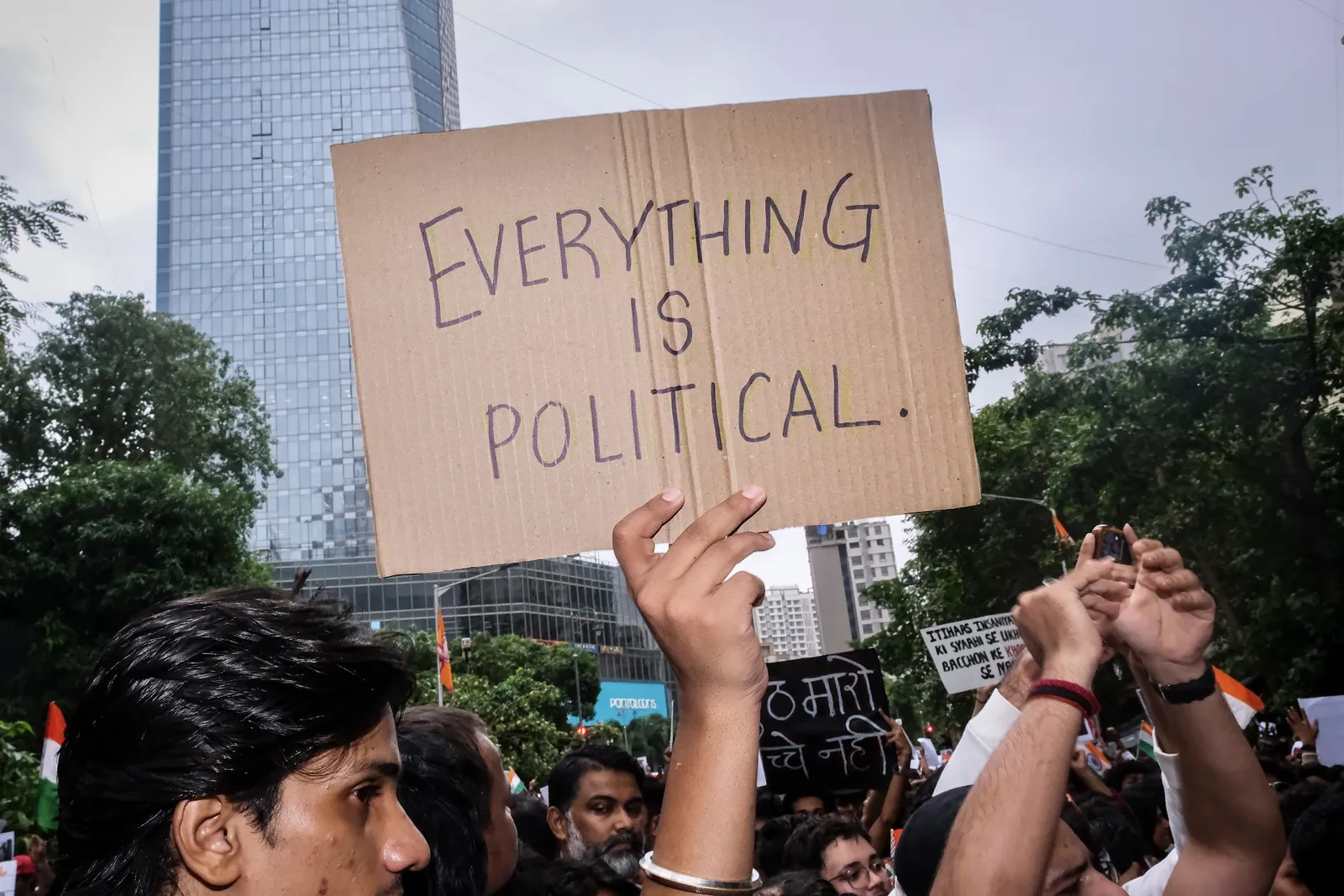
On October 10, 2026, the sun hung high with a harsh glow over Jantar Mantar, a centuries-old astronomical observatory. The 18th-century wonder was oriented towards the cosmos. It represented a key element in India's centuries-old hopes and dreams of pioneering science and technology to become one of the world's most advanced nations. The scene on the road below the towering crimson masonry stood in stark contrast to those aspirations.
Across the streets, Delhi police violently hauled female protestors, who kicked and screamed as they tried to free themselves. The protestors joined thousands of their comrades, peaceful activists fighting for systemic reform, behind bars at numerous undisclosed locations across the country. By the end of the week, although many had been released, state violence continued to spread.
“You’ve got students, teachers, students’ parents, examination aspirants,” Jatin Anand, a journalist at the Indian Express , said as he reflected on his interactions with the masses.
Despite their differences, the activists are united by a desire to address problems ranging from “sustenance and subsistence” to a broader push for “systemic change,” Anand said. That drive for institutional reform stems from broader feelings of economic and social stagnation.
These sentiments reflect India's recent all-time high in economic inequality. India’s meteoric economic rise has been well documented, with the country’s GDP per capita rising from $274 to $ 2,700 (not accounting for inflation) and GDP growth increasing from an average of 5.7% to 7.7% from the 1980s to the 2020s. However, income inequality has grown far faster than GDP has. The top 1% wealth share rose from around 6% in 1984 to almost 40% in 2023.
Yale Political Science Professor Adam Auerbach believes that these statistics indicate “India's own Gilded Age,” with “dozens and dozens of new millionaires every single day.” Those millionaires achieved their status in an ostensibly “meritocratic” system. However, protestors see such merit as a sham.
Speaking about the benefits of a university degree, Auberbach said, “There's very little on the other side in terms of stable employment, which manifests as a continued very strong preference to get jobs in the government sector.” The inability of a merit-reflecting degree to translate into employment is most evident in government jobs. The exams required to secure such jobs demand years of study and often more than two lakh rupees (the average annual Indian salary), with only around “1% making it through [to the job],” Auerbach said.
The medical sector, another desirable job market, faces similar competition that can often put extreme pressure on job-seekers. For example, leaks of the 2026 National Eligibility cum Entrance Test (NEET) allegedly caused up to 21 suicides in India.
Auerbach said that “there’s an incredible bubbling ambition of young people” to succeed in the meritocracy, but notes that “if there's not something on the other side [of achievement], it brews anxiety and resentment.” The protests reflect two sides of the same coin: the meritocratic ambition of India’s youth that births advocacy, and the resentment that makes advocacy so personal.
On October 10, 2026, the protestors came in droves. Around 7,000 tried to break past police squads in a symbolic pilgrimage to the plaza in front of Jantar Mantar. They chose the site for its proximity to Parliament and government offices.
These protests are not like their predecessors from India's tumultuous political past. The government does not have the capacity to mirror its past repression. Every person here is armed with what appears to be the most dangerous weapon of India’s newest youth movement: a phone.
That movement is the Cockroach Janta Party.
The Cockroach Janta Party is built around the digital organization of millions of urban youth across India. Rapid digital outreach and viral Instagram content enable mass coordination and mobilization of an otherwise dispersed group. Social media platforms also provide channels that circumvent India’s mainstream media suppression. While India's youth are not unique in their use of digital tools, their methods could model future Gen Z political movements.
On May 15, 2026, at the Supreme Court of India, Chief Justice Surya Kant was overseeing a case on employment. However, in an impassioned tirade bashing India’s unemployed youth, he made a comparison that appeared anything but routine in front of the court.
“There are youngsters like cockroaches, who don't get any employment and don't have any place in the profession,” said Kant during the hearing; he later clarified that he meant those with fake law degrees.
Thousands of enraged youth took to social media and expressed their outrage at perceived classism by a man at the top of a bootstrap-oriented society. The next day, Abhijeet Dipke, a Boston University student from Maharashtra, India, created a satirical post that would bring him to the forefront of one of the largest political movements in Indian history: “What if all the cockroaches come together?” he wrote on X.
What if all the cockroaches come together
Dipke also created a website for a group, the Cockroach Janta Party (CJP), parodying India's dominant right-wing party and the world's largest political party, the Bharatiya Janata Party (BJP). The website and post, both originally a joke, quickly amassed support. The CJP Instagram account (@cockroachjantaparty) skyrocketed past 25 million followers, surpassing the BJP account's 10 million.
Although the CJP is not officially registered as a party, it emerged from a desire to change education policy and morphed into a broader pressure group for democratic reforms. Support behind the post ensured that after seven weeks of near-daily protest—especially at Jantar Mantar—alongside other groups, the movement quickly achieved a key element of its platform. Dharmendra Pradhan, India’s Education Minister and a high-ranking BJP member, resigned after CJP uproar over test leaks heavily contributed to public pressure.
According to Anand, this win platformed the party. “The CJP clearly is riding on the success of its previous accomplishment, which was the dislodging of the then Education Minister of India,” he said. “They already have their credentials established in the sense that they have already delivered on this in the past.” These credentials appear reflected in the growing number of protesters at locations ranging from Amritsar, the economic center of the agricultural state of Punjab, to Lucknow, the capital of Uttar Pradesh (UP), India’s most populous northern state.
However, Dharmendra Pradhan’s ousting seems to be the first step in a much larger campaign against federal officials, namely Chief Election Commissioner Gyanesh Kumar. The CJP populated their Instagram page with posts and short-form reels disparaging the head of the Election Commission of India, who is supposed to oversee “ fair and free ” elections, from voter rolls to campaign finances. Parliament must oversee his removal, and the CJP can influence its members through public pressure but cannot control them by vote.
The CJP attempted to organize a second major mobilization at Jantar Mantar on October 10, 2026, named “Jantar Mantar 2.0,” calling for his removal. It faced strong headwinds in the form of a police crackdown and pre-emptive detentions over broader security concerns and the lateness of protest leaders formal permit application.
CJP pressure comes after the Election Commission conducted a “ Special Intensive Revision ” (SIR) aimed at removing over 130 million names from the voter rolls to ensure deceased or relocated voters are no longer on the voter rolls. Opposition parties have argued that the maintenance functionally disenfranchises millions of registered voters. As questions of constitutionality grew over the disenfranchisement the SIR facilitated, the CJP protests did not prompt the Supreme Court to enact an interim stay on the SIR—as opposition leaders had hoped .
In West Bengal, a state with a large Muslim minority population that mostly opposes the BJP, voters found that their names weren’t on the voter rolls after going to the ballot box. In West Bengal alone, an estimated 2.7 million voters had their voter status left to tribunals and faced challenging documentation requirements for verifying registration. Chaos worsened when AI software challenged some successful registrants over documentation discrepancies, prolonging disenfranchisement.
Critics in opposition parties and religious minority groups claim that such requirements and removals disproportionately affected those in opposition—especially Muslims— to the BJP, allowing it to gain new heights in political power.
While causation is disputed, the BJP swept West Bengal state elections for the first time this year.
On October 15, 2026, amid protests and legal scrutiny from India’s Supreme Court, the Election Commission announced the annual “Special Summary Revision”—a measure that allows widespread voter enrollment for the youth and newly citizens—after the SIR had delayed it. They also announced a “ special drive ” to ensure those “left out” can re-enroll more easily.
The original federal-level success also sparked an expansion to non-policy efforts. “The CJP had already embarked on a nationwide campaign, which mainly limited itself to reforming existing infrastructure at health facilities and schools,” Anand explained. In September, CJP leadership announced its “Kya Bolti Public” listening tour, aimed at anchoring the CJP in education among impoverished rural communities over the next few months. It reflects a broader desire to expand the support base from middle-class youth to include the agricultural communities that bear the brunt of India’s economic inequality.
On an organizational level, the CJP is practically led by Dipke, but it functionally accesses many of the benefits of a large movement through its digital reach. The primary CJP Instagram platform has regional affiliates across India’s states and territories; they post daily. Their self-proclaimed headquarters is “wherever wifi works.”
“This online presence and its ability to quickly communicate with people at scale undoubtedly has to enter into the calculus of people physically getting out onto the streets,” Auerbach said. Because CJP’s supporter base is dispersed, local events are easier to create and join. Additionally, digital participation through short-form content or posts can incite action without physically protesting, maximizing internal participation.
Externally, the movement's virality and ease of contact—Dipke frequently responds to Instagram comments—allow it to build political coalitions efficiently.
Sonam Wangchuk is a prominent political activist and educator who previously conducted politically motivated hunger strikes. His hunger strike with the CJP over Pradhan's resignation, as Anand notes, “was at the core of the entire movement.”
Wangchuk is just one of many political actors with whom the CJP has allied itself. The All India Students Association, a left-leaning student organization, joined the CJP in October protests against the election commissioner. CJP organizers also advocated for increased protections for women who experienced violence (a key coalition) at their “ Chappal Protest ” on October 8, 2026.
Linking multiple groups together creates a larger base beyond the CJP’s youth core, increasing overall impact, even if it decreases efficiency. “When organizations work one at a time, they might be able to be more efficient in the sense that they are achieving something concrete more rapidly,” said Yale School of Management Lecturer Teresa Chahine.
“But if [a broad movement] does work, it will absolutely be much more transformational in terms of really getting at the root causes and creating a very deep societal change.” The CJP’s changing agenda toward the Election Commission reflects the movement's evolution: from education reform as its starting point, CJP is now tackling broader, more ambitious institutional issues head-on.
The CJP’s desire to remain a movement with an ever-evolving vision of the people sets it apart from a social enterprise in its ability to shape societal values. “The change of the regime comes as a result of the changes that you're creating in the fabric of society,” Professor Chahine stated.
Democratic values are part of that societal fabric. The CJP’s Instagram page has been populated by posts framing the detentio n of protest leaders Saurav Das, Ashutosh Ranka, and Abhijeet Dipke as unlawful and anti-democratic, with some posts calling Prime Minister Narendra Modi a dictator. Dipke was preventively detained after he was ordered by the police not to hold a protest, while the other two were arrested after breaking past police into Jantar Mantar— a site where demonstrations have recently been banned—and waving India’s flag, the tiranga. Posts with titles like “Is It a Crime to Wave the Tiranga? Or is it a crime to snatch our right to vote?” frame the movement's success as synonymous with a fight for democracy. Those values are not a method of organization, but an emotional attempt to rouse the audience: the populace of the world's largest democracy.
The youth-led CJP movement has little representation in a Parliament dominated by older lawmakers, leaving the Cockroaches with limited political power. This could lead the CJP to align with the opposition. BJP party member Sujeet Kumar—a member of Parliament and Chairperson of the Parliamentary Standing Committee on Personnel, Public Grievances, Law and Justice—believes that “the CJPs whole agenda is to drive BJP out of power: to effect a regime change.”
His outlook is one that the movement must grapple with. A key element of BJP criticism aims to portray the CJP as a tangible opponent that’s merely a radical wing of the opposition. “We need a strong opposition in the country, but we don't need anarchists,” MP Kumar adds.
We need a strong opposition in the country, but we don't need anarchists
The opposition is most prominent in two parties. CJP alignment with the main opposition party, the Congress, risks “opening themselves up to the baggage, whether it is ideological or experiential or historical, that would come with it,” Anand explains. They must “retain their ability to mobilize so many people on the basis of the fact that we have no stake in this,” Anand said.
The CJP has already tied itself to Dipke’s former party, the Aam Aadmi Party, by virtue of his previous actions within it. It rose to power in the Delhi legislature during 2013 to 2020 (with a brief gap in 2014) on the basis of anti-corruption efforts.
“Aam Aadmi Party has already traversed this trajectory of being born out of a people's revolution, transforming into a party, dislodging other more experienced players at their own game,” said Anand. The party lost power during the 2020s; only a few regions are AAP-led. CJP leadership wants to “keep [the CJP] away from that similar fate.”
Party affiliations not only let critics target the movement as partisan, but also let the opposition steal the energy that mobilizes supporters. “Something a lot of social movements grapple with is when parties circle around and seek to co-opt and absorb that kind of energy,” Auerbach explained. “The difficulty of navigating these tightropes of sometimes wanting material support, wanting the backing of other opposition groups, can provide a little bit more of a bulwark, but that comes at a cost.” That cost could be losing disillusioned supporters to an opposition that seems easier to join than to support alongside.
Protests for election reform and accountability by the CJP have gone side by side with Rahul Gandhi, the leader of the opposition, and other prominent opposition leaders. “There can be no better opportunity than this to be able to register themselves in the eyes of the youth,” Anand explains of the opposition. To MP Kumar, this move merely confirms the CJP's agenda-seeking nature, which diminishes their credibility. In contrast, Dipke maintains that they are an independent pressure movement with no desire to be a tool of the opposition or a political party; rather, they both fight for a “common cause.”
“I'm not worried about the CJP,” MP Kumar said, referring to their ability to challenge the BJP’s electoral success. Auerbach looks below the surface: “Clearly this is a cause for worry within the Modi regime. They’re being very heavy-handed in their responses to these protests.” The conflict between the CJP and BJP over controlling each other's narrative of danger remains unresolved, but whoever succeeds will determine the level of impact the CJP has.
The CJP is equally equipped to pull Gen Z off their phones and into the streets. “Instagram is just a symptom of the fact that the country has changed like everybody else all over the world. [The movement] has to be real. It has to be quick. The caption has to be nice, and stories have to be there.”
Anand adds, “The generation in the driver's seat now is Gen Z.” Amid failing attention spans, the movement is succeeding in mobilizing the youth, compared with what Anand believes is the BJP and Congress's failing ability to do the same.
And Gen Z has certainly stepped up; “on the streets in Delhi, there is nothing that goes unreported. There is nothing that you can do in a public place anywhere in this world in 2026 where nobody will see it,” Anand explains.
Videos of people waving the tiranga and being tackled have brought millions of Gen Z members into the fold. Such content has not only outraged the youth, but also forced the BJP to reveal an almost authoritarian nature to the public. India ranks 157th out of 180 countries on the 2026 World Press Freedom Index. Instagram has become an integral platform for free political speech that the government cannot censor as easily due to proliferating accounts and content, unlike X, where the CJP account was quickly taken down. Amnesty International condemned state responses to the protests, due to a shrinking of spaces for political activism, unlawful detainment, and police brutality. Evidence of potential human rights violations became more visible through videos uploaded to social media.
“That online social media satire, humor, cynicism is very effective in mobilizing people,” Auerbach explained. Clips of sensational moments keep audiences watching. Trending audios or skits build popularity among Gen Z, associating the movement with a voice that can both hear and speak to them.
But mobilization only goes so far. The question of whether this movement will burn out still remains. “For those kids to make it to Jantar Mantar for this on the basis of this very amorphous call, in Delhi—courting arrest, must have been the first of its kind,” Anand stated. ” For these young Indian protesters, to wave an Indian flag is one thing, but to be pulled into an unmarked van and denied a lawyer in prison is a very different experience,” Auerbach said. The key question facing the CJP today—and any youth movement in the future, at least as Auerbach tells it—is how to maintain enough political energy to mobilize and organize.
“They seem to be in the middle. They're walking. It's a very thin path, and it's a very razor path,” Anand concluded. But perhaps the group best suited to walk the narrow path of political life is the unkillable cockroach.
They seem to be in the middle. They're walking. It's a very thin path, and it's a very razor path